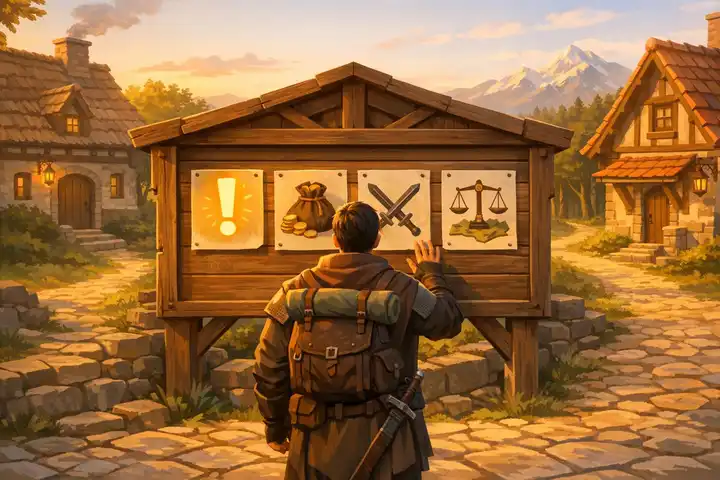
Side quests can make or break your game world. Done right, they add depth, variety, and player engagement. This guide covers 10 practical tips to design side quests that players will love:
- Strong Opening Hooks: Start with a gripping reason to care - personal stakes, dramatic events, or enticing rewards.
- Mix Quest Types: Combine combat, puzzles, social interactions, and exploration to keep things interesting.
- Connect to Main Story: Tie side quests to lore or main events to make them feel relevant.
- Choices and Consequences: Let player decisions impact the world and narrative for a personal touch.
- Meaningful Rewards: Offer items, abilities, or story revelations that align with player goals.
- Quest Chains: Link multiple quests into a larger, evolving story.
- Responsive Design: Make NPCs and the world react to player actions for immersion.
- Keep It Short: Avoid dragging side quests out - focus on clear objectives and pacing.
- World-Building: Use side quests to show off unique details of your game world.
- Avoid Repetition: Track quest variety to prevent monotony and maintain player interest.
These tips ensure side quests feel purposeful, engaging, and rewarding. Start small - add a twist to a simple fetch quest or let failure lead to new story paths. Test and refine based on player feedback to create memorable adventures.

10 Essential Tips for Better Side Quest Design in RPGs
Steal This Formula! Irresistible DnD Side Quest Ideas
1. Create Strong Opening Hooks
A side quest needs to grab players right away, sparking curiosity and driving them to take action. These opening moments are crucial for setting the tone of the adventure.
"Every quest needs a hook - something that grabs the player's attention and makes them want to learn more." - Toxigon
The best hooks build on what players already care about. Connect the hook to familiar NPCs or unresolved personal storylines to make it feel meaningful. For example, a mysterious letter addressed to one of the player characters instantly raises personal stakes - far more engaging than a generic notice on a tavern board.
How you present the hook matters just as much as the hook itself. Use action to introduce the story: maybe the party is ambushed during a quiet rest, they stumble upon bloodstains leading to an abandoned campsite, or a trusted NPC shows up injured and desperate. These scenarios draw players in through drama and atmosphere.
"If the player doesn't know why they're doing what they're doing, then the player won't be engaged with the quest." - ZorbaTHut, Game Developer
Offer a clear and enticing reward upfront. Players are more likely to bite if the hook hints at something they value - rare magical items, key story insights, or access to hidden areas. The trick is to make the reward feel relevant to the players’ goals, not just flashy loot for its own sake. A strong hook naturally sets the stage for the rest of the quest.
2. Mix Different Quest Types
To keep gameplay engaging, it's essential to mix up the types of quests you offer. Variety keeps things interesting. If every side quest boils down to "go here, kill this", players will lose interest fast. The key is to alternate between different quest styles like combat, social dialogue, investigation, puzzle-solving, and exploration. This way, each quest feels distinct and offers a fresh experience.
"More of one thing means less of another." - Tim Cain, Co-creator of Fallout
This approach works in practice. In late 2025, a small indie team noticed players were quitting after just three hours of gameplay. Their analysis revealed that 70% of quests were repetitive fetch tasks. By reworking 30% of these into social and mystery-based quests, they saw a 14% increase in 7-day player retention after just two updates. That’s a clear example of how variety can make a tangible difference.
Different quests resonate with different players. Combat quests are perfect for tactical thinkers, while mystery and investigation challenges captivate lore enthusiasts. Social quests reward players who enjoy interacting with characters, and puzzles test problem-solving skills instead of relying on dice rolls. By rotating quest types, you ensure everyone at the table finds something they enjoy.
Be intentional about how you distribute quests. Early game areas might lean more on fetch or cleanup quests (about 40%) to help players learn the mechanics. As the game progresses, aim for more social and mystery-driven content, with around 25% of quests focusing on deeper engagement. Keep an eye on your quest lineup - if you notice several "kill X enemies" tasks in a row, swap one out for a negotiation or a riddle. This not only keeps players intrigued but also helps build interconnected quest chains that feel more dynamic and rewarding.
3. Connect to Main Story and Lore
Side quests work best when they feel like a natural extension of the main story, rather than unrelated distractions. The most engaging ones reveal backstory, hint at future events, or expand your understanding of the game world. When side quests feel disconnected, they can lessen a player’s sense of accomplishment. As video game enthusiast Michael Fincher observed:
"The fact that side missions are so detached from the main storyline can feel a bit disappointing. It takes away from your accomplishments, as they seem to have little to no relevance to what is happening in the world".
By tying side quests to the main narrative, you can make them feel essential. Take Cyberpunk 2077 as an example: the side quest "Queen of the Highway" lets players assist Panam Palmer, a nomad character. Completing this quest isn’t just optional - it unlocks the specific "nomad" ending for the main storyline. This kind of integration shows how side content can enhance the overall experience.
Side quests are also a great way to deliver lore in smaller, more digestible pieces. Instead of overwhelming players with lengthy exposition, use dialogue, environments, and subtle storytelling. For instance, a crumbling castle can wordlessly suggest a fallen kingdom, while an NPC might casually mention a historical event that shaped the region. These small details can deepen the world-building and even foreshadow future storylines.
Rewards for side quests should go beyond just gear or currency - story revelations can be just as satisfying. Completing a side quest might uncover a character’s hidden motives, reveal a faction's secret, or provide key context for upcoming challenges in the main story. Game designer Niki emphasizes the importance of:
"intriguing story revelations, lore snippets, or insights into the game world's history and mythology".
These types of rewards help players feel more connected to the game world, making their efforts feel meaningful.
While enriching the main story is essential, it’s also important to maintain balance. Side quests should add depth without making players feel lost if they choose to skip them. When done well, they turn what could be isolated tasks into a seamless part of the overarching narrative.
4. Give Players Choices and Consequences
After crafting engaging hooks and diverse quest types, adding meaningful choices can elevate side quests to a whole new level. These choices give players a sense of agency and make their journey through the game feel personal and impactful.
Side quests truly stand out when players face decisions that shape the narrative in significant ways. As game developer Brice Morrison points out:
"Meaningful choices pull at players' heart strings, making them look inside themselves. These choices are remembered as deeply emotional experiences, the moments that turn a game into art".
To make a choice feel authentic, it needs four key elements: Awareness (players must know they’re making a decision), Gameplay Consequences (the choice must affect the mechanics or story), Reminders (NPCs should reference the decision later), and Permanence (the choice cannot be undone). Leaving out any of these elements risks reducing the choice to something trivial.
When done right, choices resonate throughout the game. For example, an NPC might later confront the player with, “You never backed me up!”. These callbacks turn seemingly small decisions into moments of pride - or regret. And when players fail a challenge, avoid generic “Game Over” screens. Instead, let failure open up new narrative paths: maybe they’re captured, lose a critical item, or make a dangerous new enemy.
Choices should feel like branching roads, not quizzes with a “right” answer. Each option should lead to distinct outcomes, and none should feel objectively better than the others. Morrison emphasizes the importance of permanence:
"The reason that choices in real life are so fraught with emotion, with sadness, with purpose, is because they are permanent. We can't live our lives over again".
This same principle applies in games. If players can’t reload to explore every option, their decisions carry genuine weight.
Tie the consequences of these choices to what players care about most - whether it’s unlocking unique lore, gaining special abilities, or recruiting new allies. Some side quests might even influence the main story’s ending, proving to players that their optional content holds real significance. And don’t stop at altering dialogue or visuals - ensure these choices have a tangible impact on the game’s mechanics or world.
5. Provide Useful Rewards
Side quest rewards should feel like they matter - whether it's experience points, unique gear, new abilities, in-game currency, or deeper story insights. The effort players put into a quest should align with the payoff: tougher quests deserve bigger rewards, while simpler ones can stick to smaller prizes. A great way to keep things interesting is by offering exclusive items or benefits that players can't get through the main storyline.
Not all rewards need to be physical. A powerful ally, uncovering a hidden world secret, or gaining a new ability can be just as satisfying. As game developer Niki explains:
"the definition of 'meaningful reward' may change depending on the type of the side quest or game".
Story-driven rewards, like lore snippets or revelations, are another fantastic option. They can add depth to the game world and enrich the main storyline without disrupting combat balance.
To make rewards even more engaging, consider tailoring them to different playstyles. For example, collectors might value rare items, magic-users could appreciate new spells, and players who love storytelling will enjoy narrative progression. By doing this, you avoid "Reward Imbalance", where a player feels their effort wasn’t worth the outcome because the reward didn’t match their interests or the challenge.
It’s also worth rewarding creativity and roleplay. Clever problem-solving or unique approaches to quests can earn players benefits beyond the usual loot. Side quests can even unlock secret dungeons or bonus challenges, encouraging exploration while keeping players from becoming too overpowered for the main campaign. These strategies not only enhance player engagement but also strengthen the overall world-building of your game, ensuring side quests feel like a natural extension of the adventure rather than a distraction.
6. Create Connected Quest Chains
Weaving side quests into linked, multi-part narratives can turn simple tasks like "fetch this" or "defeat that" into engaging story arcs with a clear progression. These quest chains give players a sense of continuity, offering a beginning, middle, and end that feels purposeful. Plus, they set the stage for unexpected twists along the way.
The real magic of quest chains? Delayed revelations. As LitRPG Reads puts it:
"The little goblin encounter in Session 3 feels like a throwaway battle until you drop a bombshell in Session 8 that the goblins were spies for the dark sorcerer."
Moments like these make earlier encounters feel intentional, pulling everything together into a cohesive and rewarding campaign.
Start with a straightforward issue - say, bandits attacking a village. Over time, reveal how this problem ties into a larger narrative, like a rebellion threatening the entire kingdom. By layering the story like this, you keep players intrigued while building toward a dramatic conclusion. To maintain interest throughout a lengthy quest chain, mix up the gameplay. Alternate between combat, social roleplay (like brokering peace at a tense political gathering), and puzzles to keep things fresh and engaging.
Planning is key here. Use tools like flowcharts or outlines to map out the quest chain, ensuring it stays logical and free of plot holes. It also helps to make the world feel responsive to player choices. For example, NPCs might react differently based on earlier decisions, or a minor antagonist from the first quest could evolve into a recurring rival. These touches make the game world feel alive, where actions have genuine consequences.
7. Make Quests Respond to Player Actions
Quests that react to player choices can transform a game from feeling static to feeling alive. When non-player characters (NPCs) remember past interactions and the game world evolves based on player behavior, it creates a deeper sense of immersion. This approach makes the player’s decisions feel impactful, tying their choices directly to the unfolding narrative.
One way to achieve this is by using relationship systems to track player decisions. NPCs can then respond differently depending on past encounters. For instance, if a player steals from a merchant’s faction, that merchant might refuse to trade or hike up their prices. On the other hand, helping defend a village could lead to discounts or access to hidden resources and information.
Avoid limiting outcomes to simple "success" or "failure" scenarios. Instead, design failure paths that open up new possibilities. For example, losing a fight might lead to the player being captured, sparking a quest to escape. Similarly, missing a time-sensitive goal could strengthen the villain, altering future challenges. As Raiden Studio explains:
"The goal isn't randomness for its sake, but creating a world that responds meaningfully to player actions".
Environmental changes can also reflect player impact. Over-hunting animals in a region might reduce their population, leading to an increase in predators or scavengers. This shift could prompt quests where locals ask for help managing the ecological imbalance. Similarly, excessive resource harvesting might make certain materials scarce, affecting gameplay and forcing players to adapt.
To manage these dynamic elements, use tools like flowcharts or state machines to map out choices and their consequences. This helps maintain narrative consistency while avoiding plot holes. Combine scheduled events, random encounters, and player-triggered changes to create a world that feels alive and constantly evolving based on the player’s actions.
8. Keep Quests Short and Enjoyable
When designing side quests, brevity and clarity can create experiences that stick with players without dragging on. Short quests don’t have to feel shallow - they just need a solid structure. Start with a Hook to grab attention, follow it with a clear Objective, introduce Obstacles to challenge the players, and wrap it up with a satisfying Resolution that includes rewards or closure.
To keep these quests exciting, mix up the pacing. Alternate between combat, exploration, and puzzles to avoid monotony. For example, after an intense battle, give players a quieter moment - like stumbling upon a hidden shrine or having a meaningful conversation with a non-player character (NPC). As Tim Cain, co-creator of Fallout, wisely stated:
"more of one thing means less of another".
Too much combat can feel repetitive, while endless dialogue can bog down the session.
Tone variation is another way to make side quests shine. Use them as opportunities to inject humor or heartwarming moments. These lighter moments provide a refreshing contrast to the main story’s intensity, making both the primary and secondary content more impactful. Also, balance the difficulty of encounters so players succeed about 70% of the time. This keeps things challenging but not frustrating, as overly easy or excessively hard quests can dampen enjoyment.
Even in short quests, failure can be an opportunity. A lost fight might lead to a capture scenario with an exciting escape objective, or a missed goal could strengthen the villain’s position. Player agency is crucial here - offering multiple solutions, like stealth, combat, or negotiation, makes the quest feel more personal and rewarding.
Lastly, lean on environmental storytelling to convey depth without long explanations. For instance, bloodstains leading to a hidden path or architectural details hinting at a building’s history can tell a story without words. This approach respects players’ time while still delivering meaningful narrative moments. Even brief detours can feel rich and worthwhile when handled this way. Up next, we’ll dive into how responsive quest design can deepen immersion in your campaign.
9. Use Quests to Build Your World
Side quests are a fantastic way to dive deeper into your game's world, offering details and stories that the main narrative might not have room to explore. As Mark Wilson puts it:
"Bringing a setting to life is an eminently valid reason for side quests".
These quests can highlight the local flavor of your setting. Think about a town dealing with a bug infestation, a stolen family heirloom, or mysterious ruins just outside a village. Each of these adds personality and depth to the world.
Environmental storytelling plays a big role in making side quests more immersive. Tools like audio logs, journals, or even in-game newspapers can give players a window into the lives and struggles of the inhabitants. For example, a quest might reveal hidden weapon caches in a forest from a past war or show how a receding lake uncovers ancient ruins, hinting at a long-lost civilization.
The Arkham series is a great example of how to connect side quests to the larger world. In Arkham Asylum, completing the Riddler quest gave players a small audio clip as a reward. Arkham City took this further by ending the same type of quest with a direct confrontation with the Riddler himself, making the side quest feel more impactful and tied into the world.
Consider introducing mysterious elements - what some call "The Unknown." For instance, a bottomless chasm that players can investigate, even if it doesn't directly tie into the main campaign. These unexplained features encourage exploration and make the world feel alive and layered. You can also use quest chains to reveal unexpected connections between minor NPCs, adding depth to characters that might otherwise go unnoticed.
10. Avoid Repetitive Quest Design
Repetitive quests can quickly drain the excitement from a game, especially when they make up as much as 70% of the content. Overusing a single quest type - like endless fetch or cleanup missions - leaves players feeling like they're stuck in a loop. And that’s when they start to disengage.
"More of one thing means less of another".
To keep things fresh, track your quest variety. A helpful tool for this is the Quest Diversity Index (QDI). This system measures variety on a scale: a score of 0 means all quests are identical, while a score of 0.88 signals a balanced mix across nine different quest types. Many modern designers rely on this method to keep players interested and avoid fatigue.
Combat encounters can also benefit from some creativity. Instead of just throwing more enemies at players, mix things up with modifiers. Add environmental hazards, time-sensitive objectives, or enemies that behave in unexpected ways. Imagine a fight in a room that’s slowly flooding, or enemies that adapt their tactics based on the player’s choices. Aim for players to succeed about 70% of the time - winning too easily gets boring, but constant failure is frustrating.
And when failure does happen, make it part of the story. Rather than a simple "game over", introduce meaningful setbacks: maybe the player’s character is captured, a prized item is lost, or a rival gains the upper hand. Throw in surprises, too. What if the quest-giver turns out to be the villain? Or the artifact the player retrieves is actually cursed? These twists keep the experience unpredictable and prevent quests from feeling like a repetitive checklist.
To maintain variety across your game world, consider the "10-Quest Zone" Rule. For each major area, include a mix: two trials, one cleanup, one fetch mission with a twist, one escort, one puzzle, one delivery, one stronghold strike, one mystery, and one social mediation. This approach ensures that every part of the game feels fresh and keeps players engaged.
Conclusion
These ten tips offer game masters a solid approach to crafting side quests that truly elevate a campaign. By incorporating strong hooks, diverse quest types, meaningful player choices, and personalized rewards, side quests can shift from being just optional content to becoming experiences that players actively look forward to. They’re no longer filler - they’re a chance to expand your world, deepen character arcs, and give players more control over their journey.
"The key to great quest design is to keep the player at the center of the experience." - Toxigon
Adding meaningful side quests does more than enhance your story; it strengthens player engagement. What makes these techniques so effective is their adaptability. They can fit any campaign setting, whether you’re running a gritty city adventure or an epic fantasy saga. Use side quests to adjust pacing after intense main story moments, delve into character backstories, or introduce moral dilemmas that add depth to your world. Because they’re flexible, you can include or remove them without disrupting the main narrative.
Start by making small changes - like adding a surprising twist to a fetch quest or designing a scenario where failure leads to new story developments rather than a dead end. Test these ideas in your next session and watch how your players react. If a quest doesn’t land as intended, ask for feedback and tweak it for future sessions.
These tips provide a toolkit for creating unforgettable side quests. Whether you’re browsing the TTRPG Games Directory (https://ttrpg-games.com) for inspiration or building your own homebrew campaign, these ideas work across a variety of systems and styles. Experiment with these techniques, and always keep your players at the center of every quest decision. For more RPG inspiration, check out the TTRPG Games Directory.
FAQs
How do I write a side quest hook players actually care about?
To craft a side quest hook that players will genuinely care about, begin with an idea that sparks curiosity or feels relatable. This could be a gripping mystery, an NPC struggling with a personal issue, or something directly tied to the characters' overarching goals. Build on this by placing the quest in a vivid setting and introducing characters that feel alive and engaging. The real trick is to offer players something that feels worthwhile - whether it's meaningful choices, impactful story developments, or rewards that resonate with their journey.
How can side quests matter without being required for the main story?
Side quests bring an extra layer of depth and engagement to games by expanding the lore, fleshing out characters, and making the world feel more alive. When crafted with care, these optional missions become standout moments that enhance the gaming experience. They give players the chance to dive deeper into character backstories, discover hidden narratives, or snag special rewards, making every decision feel meaningful. Well-executed side quests seamlessly support the main storyline without coming across as tedious.
How do I avoid repetitive side quests in a long campaign?
To avoid side quests becoming monotonous in a lengthy campaign, mix up their types, tone, and objectives. Add unexpected twists, introduce memorable NPCs, and use environmental storytelling to keep players intrigued. Ensure quests feel optional yet worthwhile, tying them into the world to deepen immersion. Adjust the pacing and scale of each quest to keep things dynamic, making sure every side adventure offers a fresh and engaging experience.


