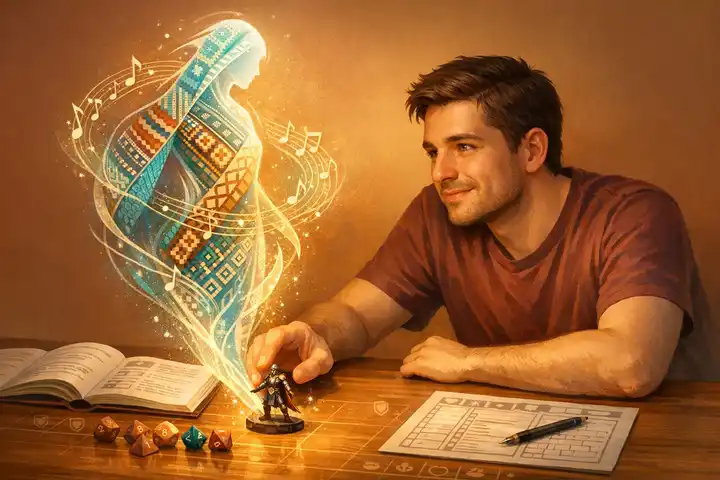
Tabletop RPGs (TTRPGs) are more than just games - they're platforms for storytelling, creativity, and exploring identity. Here's the core takeaway: TTRPGs use art, music, and mechanics to shape immersive worlds that reflect societal values, traditions, and even biases. Players, in turn, use these spaces to express and challenge identities, creating dynamic narratives.
Key points include:
- Cultural Identity in TTRPGs: Designers build fictional societies by defining values, traditions, taboos, and daily life. These elements transform game worlds into engaging settings.
- Role of Art and Music: Visuals (like character designs and architecture) and sound (like ambient noise and music) deepen immersion and storytelling.
- Representation and Bias: Early TTRPGs reflected societal biases, but modern efforts (like Dungeons & Dragons' diversity initiatives) aim for broader representation.
- Player Expression: Players use character creation to explore personal and alternative identities, often influenced by game art and mechanics.
- Fan Contributions: Communities expand games through art, music, and content, adding diverse perspectives.
In short, TTRPGs are evolving spaces where art, story, and identity intersect, offering players opportunities to engage with and reshape narratives.

How Cultural Identity Shapes TTRPG Experiences: From Design to Player Expression
Academic Frameworks: Identity and Representation in RPGs
Representation in Collaborative Storytelling
Tabletop RPGs stand apart from other media because they thrive on collaborative storytelling - a group effort where the narrative evolves collectively rather than being dictated by a single author. Antero Garcia from Stanford University highlights this dynamic, stating, "The rules of D&D function as 'constituents of culture'... as they are artifacts that mediate group understanding and individual learning". Essentially, the mechanics and systems of these games carry the biases and perspectives of their creators, shaping the game world and its interactions.
Scholars have identified three ways players interact with group narratives: identification, disidentification, and non-identification. These modes help explain how individuals navigate their role in collaborative storytelling. For instance, Nina Feng's autoethnographic study of a Rifts group sheds light on disidentification. As the only woman of color in a predominantly white, former LDS player group, Feng used disidentification as a means of navigating the group's dynamics. She explains:
"Disidentification is a critical performative process where a subject may work fluidly within and against a master narrative for political purposes".
This highlights how players can both engage with and push back against dominant narratives in their gaming experiences.
Research on Art and Identity
The visual and mechanical design of RPGs also plays a key role in shaping and reflecting cultural identity, extending beyond just narrative and sound.
Artwork in RPGs not only serves as a visual guide but also reinforces cultural norms. TiMar Long’s analysis of Dungeons & Dragons editions points out ongoing disparities in racial representation, even as later editions made some strides toward inclusivity.
Mechanically, early editions of D&D mirrored societal structures of the 1970s. The six attribute scores reflected contemporary views on labor divisions, class, race, and ability. Over time, the introduction of hybrid classes in newer systems began to reflect more nuanced and complex social identities. These changes show how game design evolves alongside broader cultural conversations about identity and representation.
Examples from Popular TTRPGs
Dungeons & Dragons: Multiple Influences
Over the years, Dungeons & Dragons (D&D) has used its evolving artwork to create a shared visual language for fantasy. What started as simple, instructional sketches has grown into detailed, full-color illustrations that define how players imagine monsters, characters, and gear. As noted by Michael Witwer, Kyle Newman, Jon Peterson, and Sam Witwer, this relationship is reciprocal: "the art informed the game, and the game informed the art".
However, this visual language hasn't always been welcoming to everyone. Researchers Antoine Premont and Samuel Heine from Université de Montréal found that early D&D artwork and rules often reflected a narrow, "essentialist definition of race", rooted in an idealized vision of colonial Europe. For example, descriptions of humans and half-humans (like half-elves and half-orcs) frequently reinforced the idea of an imperialist human race, favoring this over a more varied and inclusive portrayal of humanity.
A noticeable shift began on November 19, 2020, when Wizards of the Coast released their "Diversity and Dungeons & Dragons" statement. This was followed by the publication of Tasha's Cauldron of Everything, which marked a move toward broader cultural representation in both the game's rules and its artwork. While D&D has taken steps toward inclusivity, other TTRPGs, like Rifts, explore identity through entirely different lenses.
Rifts: Identity in a Sci-Fi Fantasy Setting
Rifts offers a distinct approach, blending science fiction and fantasy to create a "multi-genre" identity. Its artwork showcases a collision of high-tech elements - like power armor and giant robots - with magical ones, such as dragons and flaming swords. This visual style emphasizes the stark contrast between technology and magic, which is central to the game's world.
In Rifts, cultural identities are often tied to where they fall on this tech-versus-magic spectrum. For instance, the Coalition States are depicted with a rigid, high-tech military aesthetic, while the Federation of Magic leans into supernatural and mystical imagery. Specific settings, such as Rifts: England, highlight this further. Here, factions like the House of the Hawk are defined by their cultural nuances, such as their focus on quick, hand-to-hand combat, distinctive attire, and a celebration of music and arts.
Despite its imaginative world-building, Rifts has faced criticism for its portrayal of non-Western cultures. Graeme Barber from POCGamer points out that Rifts Africa exemplifies issues of stereotyping and exclusion. The continent is often treated as a backdrop for non-African adventurers, and its representation in the artwork is sparse and problematic. Only 9.8% of the interior illustrations (7 out of 71) feature non-monstrous Africans, and these depictions often show them in "traditional" clothing rather than engaging with the game's advanced technology. Worse, the first image of Africans doesn’t appear until page 41, where they are shown as porters for a white big game hunter. These issues highlight ongoing challenges in creating truly inclusive representation in TTRPGs.
Player Perspectives: Identity and Creative Expression
How Players Express Identity Through Characters
When it comes to gaming, players often use character creation as a way to explore and express their identities in deeply personal ways. This goes beyond just picking a name or a look - it’s about stepping into alternative perspectives. A 2024 survey of 19 experienced tabletop role-playing game (TTRPG) players found that many use gameplay to experiment with identities, including exploring different genders, sexualities, and moral viewpoints. Allen Barnhart, who holds a Master of Rhetoric and Composition, summed it up perfectly:
"Players frequently explore alternative perspectives and identities through gameplay".
For BIPOC players, this process can carry even more weight. Jordan K. Posey, Doctor of Education, highlighted how identity plays a pivotal role in shaping not just character creation but the overall gaming experience:
"the findings illuminated how participants' identities shaped overall gameplay experiences and their approach to character creation".
Interestingly, players often start by creating characters that mirror aspects of themselves. Over time, these characters grow and evolve, reflecting changes in self-perception as well. Even the artwork in rulebooks influences this journey. The visual designs serve as inspiration, helping players imagine and express their characters' cultural backgrounds and identities.
Fan-Created Art and Music
The creativity doesn’t stop at character creation - fan communities take it further, transforming TTRPGs into collaborative hubs for cultural expression through art and music.
Take MÖRK BORG, for example. This game has sparked a wave of fan-driven content, including hacks, adventures, monsters, and zines - hundreds of them. PS Berge noted how the game acts as:
"a toolkit for inclusive, remixable design".
Its bold visual style and typography inspire creators to craft their own content while still maintaining the game’s distinct aesthetic.
This culture of remixing and collaboration goes beyond individual efforts. Antero Garcia from Stanford University described TTRPGs like Dungeons & Dragons as:
"an analog toolset for group production of cultural artifacts, narratives, and expressions of agency".
Players often infuse their creations with real-world cultural elements. For instance, some draw from East African and Somali textile patterns or design character postures influenced by traditional flowing robes instead of typical tactical gear. These contributions push back against the "White by Default" issue in gaming, offering richer, more inclusive representation. Fan-made content helps players see themselves in ways that official artwork sometimes fails to achieve.
Conclusion
Why Cultural Identity Matters in TTRPGs
Art and music in tabletop role-playing games (TTRPGs) create immersive spaces where players can explore and reshape their identities. By weaving specific cultural details into game design, creators build worlds that feel both authentic and relatable. As Amira Hassan, Senior Editor & Game Culture Strategist, puts it:
"Specific cultural details can paradoxically make a character feel more universal".
But cultural identity in TTRPGs goes beyond aesthetics. These games offer "safe spaces" for players to explore confidence, social roles, and even their heritage through character play. For underrepresented players, seeing themselves reflected as heroes in the narrative transforms their role from passive observer to active participant. Victoria Koops, Author and Counselor, eloquently explains:
"Who We Are in Real Life might just begin with who we are in game".
Incorporating authentic cultural consultancy has also been shown to increase player satisfaction by up to 30% in regional markets. This approach doesn’t just improve representation - it creates gaming experiences that connect on a deeper level, allowing players to learn and grow through active participation rather than passive storytelling. From collaborative narratives to fan-driven art, cultural identity profoundly shapes how players engage with and experience TTRPGs.
Finding Games Through TTRPG Games Directory

If you're ready to explore culturally rich TTRPGs, the TTRPG Games Directory (https://ttrpg-games.com) is a great place to start. This resource showcases games that seamlessly integrate cultural identity into their mechanics, themes, and storytelling. Each listing includes detailed descriptions, making it easier to discover titles created by diverse designers who bring authentic perspectives to their work.
Whether you're drawn to classic titles or indie creations, the directory highlights games that use cultural specificity to craft unforgettable experiences for your table.
What Makes Good TTRPG Art | Chaosium Interview

FAQs
How do RPG rules encode cultural values or bias?
RPG rules often reflect societal values and biases through their portrayal of characters, themes, and the societal norms woven into their game mechanics. Take Dungeons & Dragons as an example - earlier editions of the game faced criticism for underrepresenting racial minorities and perpetuating stereotypes. Beyond representation, the mechanics and narratives of these games can mirror broader societal biases, subtly shaping how players perceive identity and power. In this way, RPGs act as cultural artifacts, carrying and transmitting societal values that influence players' experiences and interpretations of the game world.
What makes RPG art and music feel culturally authentic?
RPG art and music feel genuine and impactful when they thoughtfully integrate elements that reflect specific cultures with care and accuracy. This means drawing inspiration from traditional visual designs, storytelling techniques, and musical styles rooted in historical and cultural contexts. Collaboration with experts from these cultures plays a key role in ensuring respectful and accurate representation, steering clear of harmful stereotypes. By prioritizing meaningful and informed portrayal, these creative efforts not only immerse players but also pay homage to the cultures they represent.
How can a group improve representation at the table?
To create a more welcoming and inclusive environment, it's essential to embrace and respect different cultural backgrounds, identities, and perspectives. Incorporate materials that showcase a range of diverse characters and encourage participants to explore varied experiences in their creative endeavors. Take the time to learn about cultural nuances, steer clear of stereotypes, and approach worldbuilding with care and respect. Maintaining open dialogue, actively seeking feedback, and being willing to adjust are all crucial steps toward building an environment where everyone feels represented and valued.


