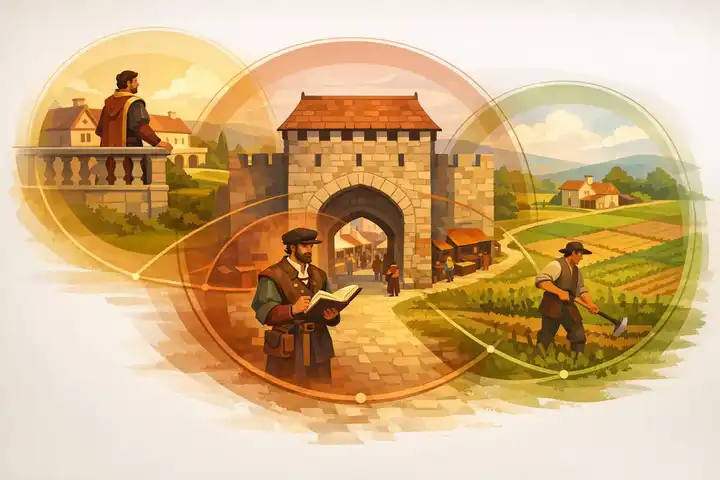
Creating believable NPCs for TTRPGs becomes easier when you draw from medieval history. Here's the key takeaway: start with historical systems like feudalism, social hierarchies, and medieval economics to ground your world, then layer in fantasy elements. This approach ensures your NPCs feel realistic and relatable while enhancing your campaign's depth.
Key points include:
- Feudal Hierarchy: Most NPCs will be commoners (farmers, craftsmen), not nobles. Only 0.2% of the population were titled nobility.
- Three Estates: Society divided into fighters (knights), clergy (priests), and workers (peasants, artisans). Clergy offered rare social mobility.
- Urban vs. Rural Life: Rural NPCs focused on survival; urban NPCs were profit-driven, tied to guilds and trade.
- Medieval Economics: Barter dominated rural areas, while cities relied on coin and guild systems. NPC motivations often stemmed from resource scarcity or trade disputes.
- Religion and Law: Faith shaped identities, and local manorial courts handled disputes. Outlaws lacked legal protection, adding narrative stakes.
Turn Crazy Merovingian History into EPIC fantasy!
Medieval Social Structures for NPC Design

Medieval NPC World-Building: Rural vs. Urban Society at a Glance
Drawing inspiration from historical conflicts and economic dynamics, medieval social structures offer a rich framework for creating layered and believable NPCs.
Medieval Europe was a deeply hierarchical society where a person's birth largely determined their role in life. This rigid structure provides a natural starting point for designing NPCs with clearly defined roles and relationships.
Feudalism and NPC Roles
The feudal system is an excellent model for NPC hierarchies. At the top of this pyramid stood the king, followed by ranks of dukes, earls, barons, and knights. This structure, known as subinfeudation, created a cascade of land ownership and responsibilities, with each vassal managing smaller pieces of land beneath them.
A practical way to reflect this in NPC design is to emphasize the wealth disparity within the noble class. Historically, nobles were rich in land but often short on liquid assets, forcing them to rely on borrowing from merchants or trading favors to finance their needs. For example, in 14th-century England, the titled nobility made up a minuscule part of the population - only 50 to 80 individuals out of roughly 5,000,000 people, or less than 0.2%. This means the vast majority of NPCs your players encounter should be commoners, not members of the aristocracy.
This overarching hierarchy ties neatly into the broader division of medieval society, which further defines NPC roles.
The Three Estates: Fighters, Clergy, and Workers
Medieval society was also divided into three philosophical categories: those who fight (nobles and knights), those who pray (clergy), and those who work (peasants and craftsmen). This tripartite model not only reflects historical thought but also adds depth to NPC motivations and interactions.
"Medieval political speculation is imbued to the marrow with the idea of a structure of society based upon distinct orders." - Johan Huizinga, Historian
The clergy stands out as a particularly dynamic group. Unlike other estates, it allowed for significant social mobility. A peasant's son could rise through the ranks to become a bishop, creating opportunities for unique NPC backstories. Additionally, consider including characters who existed outside these estates entirely - outlaws, vagrants, minstrels, and mercenaries - who often operated without legal protection or formal ties to society.
Urban vs. Rural NPC Societies
An NPC's environment - urban or rural - shapes their daily life and motivations. In medieval times, rural populations made up 80–90% of society. These individuals, often tied to the land through manorial law, were largely focused on survival and deeply risk-averse. Urban dwellers, on the other hand, lived under royal charters, paid taxes in coin, and were organized into guilds and trade networks.
| Feature | Rural NPCs | Urban NPCs |
|---|---|---|
| Primary class | Peasants, serfs, manorial lords | Merchants, artisans, burghers |
| Legal status | Bound by feudal labor obligations | Exempt from feudal labor; paid coin taxes |
| Social fabric | Relationship-based; high mutual accountability | Specialized; organized by guilds |
| Risk profile | Risk-averse; focused on survival | Profit-oriented; focused on commerce |
One compelling historical mechanic to incorporate is the "year and a day" rule. This law allowed a serf who escaped to a town and remained unclaimed for a year and a day to gain their freedom. Urban NPCs should also feel interconnected with the rural countryside. Cities depended heavily on nearby farmland for survival, and disruptions to these agricultural systems could have immediate and far-reaching consequences for urban life. These interdependencies between rural and urban societies offer fertile ground for NPC motivations and the legal systems discussed in later sections.
Medieval Economics and NPC Motivations
Building on the framework of feudal and societal roles, the economic realities of the medieval period play a key role in shaping NPC behavior and interactions.
Everyday Economy and NPC Needs
In rural areas, barter was the backbone of economic life, with gold being a rarity in daily transactions. Payments were often made in kind - a miller kept a share of the flour he ground, peasants paid rent through grain or labor, and favors were a common currency for settling obligations. This system of exchange directly influences how NPCs might interact with players. Instead of offering 50 gold pieces for clearing out a bandit camp, a village elder might reward the party with a pig, several months of lodging, or even a promise to speak on their behalf to the local lord. This scarcity of coinage adds a layer of realism to the game world.
Agriculture, the foundation of rural life, was incredibly precarious. Grain yields in medieval Europe were low, often producing only 3 to 4.7 times the seed sown. A portion of this yield had to be saved for the next planting season, leaving little margin for error. A bad harvest didn’t just mean hunger - it could lead to starvation. This constant struggle for survival made rural NPCs cautious, prioritizing social bonds and mutual aid over wealth accumulation. These conditions set the stage for the more structured and competitive urban trade dynamics discussed next.
Guilds and Craftsmen
Urban economies, in contrast to rural barter systems, revolved around guilds - powerful organizations that regulated trades within city walls. When players step into a town, they encounter an entirely different economic landscape. Guilds controlled who could legally practice a trade, and operating outside their authority wasn’t just frowned upon - it was outright illegal.
Guild membership followed a strict hierarchy: apprentice (unpaid trainee), journeyman (paid worker), and master (business owner). By 1260, Paris had 101 distinct trades organized under guilds, a number that grew to 350 by the 14th century. These professions provide fertile ground for NPC politics and rivalries.
"Guilds enabled their members and political elites to negotiate a way of extracting rents in the manufacturing and commercial sectors, rents that neither party could have extracted on its own." - Sheilagh Ogilvie, Professor of Economic History
Conflicts between trades, such as disputes between shoemakers and cobblers, often escalated into long-standing rivalries. These tensions can translate directly into NPC storylines, with neighboring tradespeople embroiled in bitter disputes over jurisdiction and rights.
Trade, Taxes, and Corruption in NPC Stories
Long-distance trade brought both opportunity and risk, driving NPC motivations through the lure of profit and the fear of betrayal. Merchants often faced societal suspicion, as the practice of buying low and selling high was sometimes viewed as unethical. This mistrust occasionally pushed marginalized groups into these roles, creating "middleman minority" tensions that could spark conflict.
Taxes were another source of constant friction. The Church demanded a tithe - 10% of a household’s produce - while secular lords added their own rents. Local officials, such as the reeve (a peasant overseeing labor on the manor), often engaged in corruption, manipulating accounts or adjusting labor duties for personal benefit. Salt monopolies provided yet another source of tension. Since salt was essential for preserving food, nobles who controlled its production wielded enormous power over entire communities.
Transportation costs also played a significant role in trade dynamics. Moving goods by river was about five times cheaper than overland, while sea transport was twenty times cheaper. This made control over a river crossing or coastal dock a lucrative and highly contested position. An NPC merchant holding such a strategic point could wield considerable influence, naturally drawing rivals eager to seize that advantage.
Religion, Law, and Family in NPC Societies
Religion and Moral Authority
Religion played a central role in shaping medieval identities and motivations, deeply influencing how NPCs might behave in a game world. In a medieval-inspired setting, NPCs often identify themselves by their faith rather than by race or region. For instance, a merchant who shares the same religion might be seen as an ally, while someone of a different faith could be viewed as an outsider or even a rival. This simple distinction can drive faction dynamics and NPC interactions.
The Church wasn’t just a spiritual institution - it was a massive economic and political force. In fact, at the height of the medieval period, the Church owned about one-third of all land in Western Europe. Monasteries often acted as feudal lords, collecting rents and controlling local trades. This dual role means that a monastery NPC could serve as both a spiritual guide and a political power player.
Medieval NPCs often grappled with the tension between secular and religious authority. Obeying the king might keep them safe in this life, but obeying the Church promised salvation in the next. This conflict creates ready-made moral dilemmas for NPCs. For example, the Church provided 40 days of sanctuary to fugitives fleeing secular justice. Imagine the drama of a standoff between a lord’s soldiers and a priest refusing to surrender a fugitive sheltering in a temple - this kind of scenario is both historically grounded and rich with narrative potential.
In a world where magic exists, religion would likely shape how NPCs perceive it. Divine magic might be seen as a holy gift, while arcane magic could be viewed with suspicion - something unnatural and possibly heretical. This interplay between faith and power naturally extends into local justice and social dynamics.
Justice and Legal Systems
Medieval law was highly localized and personal. The smallest legal authority was the manorial court, which convened roughly every three weeks and was overseen by a lord or steward. These courts handled everyday disputes - like property boundaries, debts, or inheritance - and decisions often depended more on social alliances than on objective evidence.
Most cases were resolved based on "the custom of the manor" - essentially unwritten rules and past precedents. For GMs, this offers incredible flexibility. There’s no rigid legal code to follow; instead, judgments depend on what the lord recalls, what the elders claim happened last time, and who wields the most influence in the community.
One fascinating legal mechanism for NPC design is the tithing system. Villages were organized into groups of 10 to 15 households, and if one member committed a crime, the entire group was held accountable. This system reinforces the idea of collective responsibility. As historian Wallace Cleaves explains:
"If an individual had any redeemable qualities, he would belong to a tithing, or a community... The fact that the outlaw didn't made him a social pariah." - Wallace Cleaves
Being declared an outlaw stripped an NPC of all legal protections. Anyone could harm or even kill them without facing consequences, and aiding them was itself a crime. This makes outlaw status a powerful narrative tool, offering dramatic stakes and moral complexity.
Just as legal traditions shaped how communities functioned, family structures played a key role in determining individual fates.
Family, Gender, and Inheritance
For most peasant NPCs, life revolved around the nuclear family: a husband, wife, and their young children. The family unit wasn’t just a social structure - it was the foundation of survival, requiring careful management of scarce resources.
Land inheritance followed strict rules to maintain the viability of holdings. Instead of dividing land among all children, it typically passed to a single heir - usually the eldest son. This system forced younger sons to seek other paths, such as joining the military, entering the clergy, or working as itinerant laborers. These inheritance rules naturally suggest compelling NPC backstories, like the bitter younger brother, the wandering soldier, or the reluctant priest.
Death brought financial burdens for families. When a tenant died, the lord claimed the family’s heriot - their best asset, often an ox or a horse. Noble heirs faced a cash tax called a relief to secure their inheritance. Even marriage required the lord’s permission, with peasants paying a fee called merchet. These historical details aren’t just trivia - they’re perfect for creating believable NPC motivations. Imagine a family losing their only ox after the father’s death, leaving them desperate and vulnerable.
Women’s roles varied widely depending on their social class. Noblewomen often managed entire estates while their husbands were off at war, wielding significant authority over households and tenants. Peasant women contributed through constant labor, like brewing ale or making cloth, and even entered contracts despite limited legal rights. After the Black Death, labor shortages expanded their roles further. An NPC widow running a manor or a skilled alewife with strong community ties adds depth to your world without relying on stereotypes.
How to Build Medieval-Inspired NPCs
Crafting NPCs that feel grounded in a medieval setting requires blending historical details with practical design methods. Here's how to bring your characters to life with authenticity.
Quick Research Methods for Historical Detail
Start by considering the makeup of medieval societies. Most NPCs in your world will be farmers, not merchants or soldiers. A good rule of thumb is about 10 farmers for every urban dweller. This simple ratio lends credibility to your world without requiring deep dives into historical texts.
For towns, use occupational density ratios to quickly assign roles:
| Trade | People per 1 Professional |
|---|---|
| Blacksmith | 200:1 |
| Priest/Cleric | 100:1 |
| Healer | 500:1 |
| Wizard/Sage | 5,000:1 |
These ratios highlight just how rare certain professions were. For example, a healer or literate scribe would be a significant figure in any setting. By limiting literacy to clergy, nobility, and senior guild members, you can make educated NPCs stand out even more.
With these guidelines, you can quickly sketch out historically plausible NPC archetypes for your game.
Building NPCs from Historical Archetypes
Once you've established the basic structure of your world, use the medieval "Three Estates" (clergy, nobility, and commoners) to guide your NPCs' motivations. This framework helps define their roles, responsibilities, and social limitations.
For example, a baron might have the power to tax tenants and resolve disputes but is also expected to provide military protection and uphold justice. If they fail in these duties - or if their own liege neglects them - it creates natural opportunities for conflict and storytelling.
As one designer put it:
"Honor was a person's bond with society, and dishonor was pretty much the only way to be stripped of land and title." - sheavalentine, Living Myth RPG
When creating craftsmen NPCs, think beyond the usual blacksmith. Roles like cooper (barrel maker), chandler (candle maker), or vintner (wine producer) add depth to your towns. These professions also bring associated guilds, economic challenges, and potential storylines.
Mapping Medieval Systems onto RPG Mechanics
To reflect the rigid social structures of the time, consider assigning NPCs a Social Status Score (ranging from 3–18). This score can influence reaction rolls, wealth, and overall influence. For instance:
- A serf might score between 6 and 8, suffering a –1 penalty in social interactions.
- A landed noble with a score of 18 could enjoy a +3 bonus, commanding respect and deference.
Tie these scores to upkeep costs to add another layer of realism. For example, a knight unable to maintain a 300 gp monthly lifestyle might lose influence, impacting how others perceive and interact with them. Incorporating guild rules - where unlicensed trades are penalized - adds yet another layer of societal pressure.
As Welshpiper points out:
"A better approach to low-fantasy, then, is to start with medieval history and slowly add magic... you'll notice a major difference in the quality of your campaign if... you've established a firm non-magical foundation." - Welshpiper
Conclusion: Bringing Medieval NPC Societies to Life
Key Takeaways
Medieval history offers a solid foundation for creating believable NPC societies. By starting with historical accuracy and weaving in elements of magic, you can craft settings that feel both authentic and fantastical. As Welsh Piper aptly puts it:
"A better approach to low-fantasy, then, is to start with medieval history and slowly add magic - a few spells here, a monster there, a magic item every now and then."
Using the framework of the Three Estates - those who fight, pray, and work - helps establish realistic social dynamics and motivations for your characters. These historical structures give depth to NPCs and make towns and communities feel naturally interconnected. Even small, thoughtful details can elevate a town from being generic to feeling historically grounded.
Once you’ve built this foundation, the next step is ensuring your chosen game system aligns with your medieval-inspired vision.
Finding the Right Game System with TTRPG Games Directory

Not all game systems are designed to handle the level of detail required for historically rich settings. The TTRPG Games Directory is a fantastic resource, offering a free and thorough catalog of RPGs. It’s a great tool for finding systems that support intricate economic, social, and magical mechanics, bringing your medieval NPC societies to life.
FAQs
How do I make feudal ranks matter in play?
To make feudal ranks matter in your game, tie them to specific rights and privileges that shape how players interact. For instance, members of the nobility could wield legal authority, enjoy immunity from certain accusations, or gain access to exclusive, hidden knowledge. These perks not only reinforce the hierarchy but also give players tangible reasons to aspire to higher ranks.
Social consequences can further highlight the divide between ranks. Imagine commoners being required to show deference to nobles or facing travel restrictions based on their status. These mechanics can create natural tension and opportunities for conflict, pushing players to engage in diplomacy, manage their reputations, and fulfill obligations to their superiors or vassals. By weaving these elements into the gameplay, you encourage players to navigate the intricate web of feudal society.
What are easy ways to show barter vs. coin economy?
Currency wasn't always as accessible or universally used as it is today. In many societies, coins were scarce and primarily circulated among elites or were set aside for paying taxes. For most common folk, daily transactions relied heavily on bartering goods or exchanging labor.
Picture this: rural villagers trading sacks of grain for a neighbor's fresh eggs, or offering their skills - like repairing a roof - in return for firewood. This kind of exchange made sense for their day-to-day needs. Coins, on the other hand, were often viewed as impractical, almost like trying to buy a loaf of bread with a $100 bill today.
In urban areas, however, things looked different. Merchants and nobles often dealt in coins or even extended credit for larger transactions. The contrast was stark - while peasants in the countryside stuck to practical exchanges, city dwellers operated in a world where currency and financial systems played a more prominent role. This divide highlights how access to currency could shape the way people lived and interacted with their communities.
How can religion and local law create NPC plot hooks?
Religion and law in medieval-inspired settings open up a world of storytelling possibilities. Religion often serves as a tool to legitimize rulers, with public rituals playing a key role. These rituals can become the catalyst for adventures - imagine the chaos if a ceremony is interrupted or tied to a natural disaster that shakes public faith.
Law, on the other hand, tends to rely heavily on reputation rather than hard evidence. This creates natural tension, especially for outsiders who might face suspicion or even be scapegoated for local misfortunes. Beyond this, conflicts can spring from power struggles, like nobles attempting to curb the growing influence of merchants. Disputes over land use, monopolies, or accusations of heresy also provide fertile ground for gripping plotlines. These elements can weave together to create unforgettable adventures.


