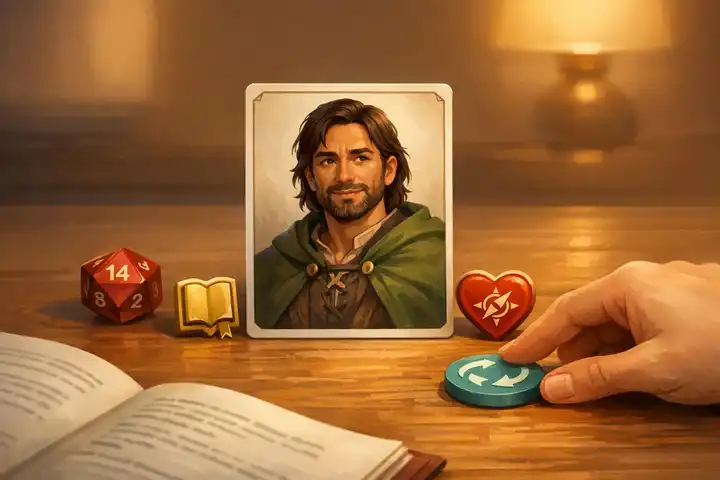
NPC AI is transforming tabletop role-playing games (TTRPGs) by making non-player characters (NPCs) more dynamic and responsive. Unlike traditional static NPCs, AI-powered NPCs can hold conversations, remember past interactions, and react to player actions in real-time. This creates richer, more immersive gameplay.
Key Takeaways:
- What’s New: AI allows NPCs to simulate memory, emotions, and decision-making, making game worlds feel more alive.
- Why It Matters: Players experience meaningful consequences as NPCs react to choices and events over time.
- How It Works: Tools like ChatGPT or Claude enable NPCs to adapt their behavior using memory systems and motivation-based logic.
- For GMs: Use frameworks like “Want, Wound, and Voice” to design NPCs that are consistent yet flexible in their actions.
This guide covers the principles, tools, and techniques for creating smarter NPCs, whether you use AI or manual methods, ensuring your TTRPG sessions are engaging and memorable.
Design Principles for NPC AI
Balancing Realism and Playability
NPCs need to feel relatable, with realistic flaws and spontaneous reactions. Game developers have discovered that making NPCs "better" often means adding imperfections - mistakes and behaviors that mimic how real people think and act.
The challenge lies in creating NPCs with just enough unpredictability to surprise players while maintaining enough consistency for strategic planning. At the same time, processing demands must stay under 15% of the total CPU frame time. If NPC behavior becomes too complex, players may find it frustrating and hard to follow. On the other hand, overly simple NPCs come across as robotic.
For game masters (GMs) running multiple NPCs, resource allocation is key. Save detailed preparation - like backstories, intricate motivations, and relationship maps - for principal NPCs who will appear across multiple sessions. As one experienced GM puts it:
"If the NPC can be replaced by a door, a sign, or a die roll, they probably don't need a backstory".
A practical method for NPC design involves motivation-driven logic. Assign each NPC a "Want" (their immediate goal) and a "Wound" (a defining past experience). This simple framework allows GMs to predict how an NPC might react to unexpected player actions without needing extensive pre-written scripts .
These principles ensure NPCs remain dynamic and consistent, enhancing the player's experience.
Consistency and Flexibility in NPC Actions
To keep NPC actions believable, start with clear motivations. For major characters, answer three essential questions: What do they want? What do they know? What will they do to protect their interests? These questions act as anchors, ensuring NPCs behave consistently even when players make unexpected moves.
Instead of relying on rigid scripts, prepare adaptable scenarios. When NPCs are guided by their core motivations, they can respond naturally to unpredictable situations. A scripted NPC might falter if players ask an unanticipated question, but one built on motivations and relationships can adjust seamlessly.
In digital or AI-assisted tabletop RPGs, layered systems help maintain this balance. Start with predictable routines, such as a guard's patrol schedule, and layer dynamic decision-making on top. For example, a "social loop" system can store NPC memories of past interactions, allowing earlier events to influence future responses.
For minor NPCs, a single distinctive trait - like touching their collar when lying, using overly formal language, or a unique verbal tic - can make them memorable without overcomplicating their role. Too many quirks risk turning them into distractions rather than meaningful characters.
Player-Centric Design
NPC behavior should revolve around player choices. The goal of NPC AI is to enhance player agency, not overshadow it. When NPCs respond the same way regardless of what players do, they feel like "vending machines" rather than characters. The most memorable moments in tabletop RPGs often come from visible consequences - when player actions ripple through NPC behavior and relationships.
This requires core reactivity. A world that ignores player decisions breaks immersion. For example, if the players help a baker, the baker's behavior toward the party should reflect that change. Adaptive NPC systems ensure the game world acknowledges and reacts to player actions in meaningful ways.
Striking the right balance between predictability and unpredictability is crucial. Players need to understand an NPC's general role and motivations, but they should also encounter occasional surprises that make the world feel alive. AI tools can help by incorporating memory systems that track interactions, observed actions, and shared information. Assigning importance scores ensures NPCs remember major events - like being rescued - more vividly than mundane interactions.
Lastly, design NPCs to reflect player choices. Characters who connect to the players' backgrounds, decisions, or fears naturally encourage deeper engagement. Not every NPC needs to be complex, but those who matter should respond meaningfully to what players do.
Self-operating NPC's - The NPC's You Never Knew You Needed
How to Implement Adaptive NPCs

AI Tools Comparison for TTRPG NPC Generation
Using AI-Assisted Tools for NPC Behavior
AI tools like ChatGPT, Claude, and Gemini can play a key role in shaping how NPCs behave by using structured prompts. Start with a system message that outlines the NPC's core traits, backstory, motivations, values, and current situation. This helps ensure the character behaves consistently across multiple interactions.
To make NPCs feel more realistic, consider using a three-tier memory system:
- Short-term memory: Tracks the last five interactions.
- Working memory: Focuses on active tasks.
- Long-term memory: Stores milestones and relationship details.
For smoother integration, request AI responses in JSON format. This allows you to map the NPC's reasoning directly into game mechanics, like dice rolls or status effects. For example:
{"action": "negotiate", "emotion": "fearful", "priority": "high"}
This structured data avoids the need to interpret natural language and makes it easier to translate into gameplay.
To keep NPCs consistent and lore-friendly, establish clear boundaries in their system prompts. Define what the NPC knows, what they don’t, and which values guide their choices. This prevents the AI from introducing out-of-character or lore-breaking details. As NPCs experience major events, update their system messages to reflect these changes, keeping their long-term memory relevant.
If you're running a campaign without AI tools, you can still apply similar adaptive techniques manually.
Manual Simulation for Non-AI Campaigns
For campaigns that skip AI, GMs can create adaptive NPCs by focusing on their motivations. Revisiting these core motivations regularly helps simulate dynamic behavior without relying on pre-written scripts.
Time management is key. Use a tiered preparation approach:
- Minimal detail for background extras.
- Brief outlines for functional NPCs.
- In-depth backstories for key characters.
Utility scoring is another handy tool. It simplifies decision-making by prioritizing factors like the NPC's health, stress levels, or immediate goals.
To stay organized, consider using index cards. Write the NPC's name, role, and one defining trait on the front. Use the back to jot down session notes and interactions with players. If players start showing extra interest - by asking for the NPC's name repeatedly, giving them a nickname, or involving them in plans - it’s a sign to flesh out that character further.
Whether you're using AI tools or manual methods, the goal remains the same: to create NPCs that adapt and grow, enriching the overall gameplay experience.
Comparing AI Tools for NPC Generation
Different AI models excel in specific areas of NPC simulation. Your choice will depend on the depth of storytelling and world-building your campaign requires.
| AI Model | Strengths for TTRPGs | Context Window |
|---|---|---|
| GPT-5.2 | Excels at reasoning and interpreting rules; fewer errors. | Standard |
| Claude Opus 4.5 | Maintains narrative continuity and character consistency. | 200K tokens |
| Gemini 3 Pro | Handles complex world-building and large rulebooks. | 1M tokens |
| Grok 4.1 | Offers real-time awareness and modern references. | Standard |
For long campaigns, context window size is crucial. Claude Opus 4.5 supports up to 200,000 tokens, while Gemini 3 Pro can handle a staggering 1 million tokens. This capacity allows for continuity across years-long campaigns and referencing entire rulebooks without losing track.
Managing NPC Behavior During Play
On-the-Fly Decision Adjustments
NPCs truly shine when they can adapt to the unexpected. If players take an unplanned route or make a surprising move, NPCs should respond in ways that feel natural and situational. Instead of rigidly sticking to scripts, equip NPCs with the ability to assess the moment. For instance, a town guard might choose to negotiate rather than fight if the players have earned a strong reputation for helping the community. These kinds of flexible decisions help maintain a sense of continuity in the story.
A useful approach here is the Want, Wound, and Voice framework. This means NPCs react based on their immediate objectives (what they want), any past conflicts or betrayals (their wounds), and their unique personality traits (their voice). This keeps their responses feeling consistent and believable.
Additionally, NPCs should interact with their environment in realistic ways. Using mechanics like line-of-sight and proximity detection, NPCs can react to player actions in real-time. For example, if players are sneaking through a tavern, the bartender might notice movement near a storage area and grow suspicious. Meanwhile, louder actions could draw the attention of other patrons nearby. These earned reactions make the world feel more alive.
Once these quick reactions are in place, integrating a memory system ensures that NPCs don’t just respond in the moment but also carry those experiences forward.
Continuity and Memory Systems
Dynamic responses are only part of the equation. To create a cohesive game world, NPCs need memory systems that track and reflect their experiences. A tiered memory structure works well for this. Here's how it can be broken down:
- Hot memories: Recent or emotionally charged events, like a betrayal, a heroic rescue, or a heated argument.
- Warm memories: Important but less immediate events, such as a trade deal or a favor granted.
- Cold memories: Routine interactions that don’t need detailed tracking, like regular purchases or casual conversations.
Not every event should carry the same weight. To keep things meaningful, memories can be scored based on factors like emotional intensity, how rare the event is, how recently it occurred, and its personal significance. For example, a murder in a peaceful village would leave a far deeper mark than a routine trade interaction. Similarly, a merchant might remember theft vividly, while a priest might focus on acts of blasphemy.
To make the game world feel interconnected, NPCs can share information through gossip networks. This allows details about player actions in one location to ripple out to other areas, influencing NPC behavior in distant towns. This creates a living, breathing social network where actions have consequences far beyond their immediate setting.
Practical Tips for TTRPG GMs
Start Small and Scale Up
It's easy for GMs to get carried away with creating overly complex systems for every NPC in their world. Instead, keep it simple at first. Focus on the basics and only add layers of complexity when it’s truly necessary. Think about the difference between minor NPCs (like the innkeeper, shopkeeper, or a random guard) and key NPCs (recurring allies, rivals, or faction leaders). For minor NPCs, all you really need is a single sentence describing their motivation and one distinct physical detail. Save your energy for key NPCs, and only invest deeply in them if they’re going to appear in at least three sessions.
A good starting point for creating adaptive NPCs is the Want, Wound, Voice framework. This structure gives you enough to improvise while keeping things consistent, without the need for complicated AI logic. Once you’re comfortable with this approach, you can experiment with more advanced elements, like memory systems or decision trees, for NPCs that capture your players’ attention.
Use TTRPG Games Directory

Once you’ve nailed down a scalable NPC design, it’s time to pick a system that supports these adaptive features. Different tabletop RPG systems handle NPC mechanics in their own way. The TTRPG Games Directory (https://ttrpg-games.com) is a great resource for finding systems that include adaptive NPC mechanics. These systems often offer features like in-game memory, faction dynamics, and reactive behaviors.
If you’re designing adaptive NPCs for a campaign, browsing games in similar genres can provide inspiration. The directory includes both classic systems with tried-and-true NPC frameworks and indie games experimenting with new social mechanics. This makes it easier to find ideas you can adapt to your own table.
Get Player Feedback
Your players are an invaluable resource when refining your NPCs. According to surveys, 76% of players want NPCs to feel more emotionally intelligent and situationally aware. However, what this looks like can vary widely between groups. Some players love NPCs who remember every interaction, while others might find that level of memory tracking exhausting. Use your session zero as a chance to talk about how reactive and autonomous your NPCs should be.
After gameplay, ask your players for feedback. Did the merchant’s response to their reputation feel natural? Was the guard captain’s sudden change of heart believable? If an NPC acts in an unexpected way, gauge whether the players saw it as character development or a system glitch. This feedback can help you troubleshoot. For example, if an AI-driven NPC says something that feels out of place, you can decide as a group whether to retcon it or integrate the odd behavior into the NPC’s personality. Keep in mind that players are more likely to notice when an NPC’s behavior feels off rather than when it works perfectly. Focus on making their actions consistent and predictable before trying to make them overly complex.
Conclusion
Key Points Recap
Adaptive NPC decision-making can transform static, predictable encounters into vibrant, reactive game worlds. The secret lies in blending design, memory, and player-driven priorities. At its core is a memory-first design approach, where NPCs track interactions and social cues, making player choices feel impactful. The most effective results come from combining AI tools for procedural generation with human guidance for emotional and narrative highlights.
To create depth, use the Want, Wound, Voice framework, especially for recurring NPCs. For background characters, a single sentence of motivation is often enough. Let information flow naturally between NPCs - when the blacksmith shares news about the players with the baker, the world feels interconnected and alive.
From a technical perspective, there are multiple tools for NPC behavior. Finite State Machines are great for basic behaviors, Behavior Trees work well for modular combat systems, and Utility AI shines in dynamic prioritization. Modern language models, like GPT-5.2 and Claude Opus 4.5, enable natural dialogue and memory retention with their expansive 200K+ context windows. The trick is choosing the right tool for each NPC - not every character needs cutting-edge AI.
These ideas set the stage for practical application.
Next Steps
Start small by experimenting with one or two key NPCs in your next session. Even a simple memory system - such as a spreadsheet to log player interactions - can make a noticeable difference. Test whether your players prefer NPCs with full recall or selective memory. As Imran Sarwar from Rockstar Games observed:
"Whether it's a shopkeeper, a lawman or a passing rider - you can interact with them in a variety of ways without ever drawing a gun... It's a huge leap forward."
For inspiration, check out the TTRPG Games Directory. It offers detailed descriptions of games featuring faction dynamics, memory systems, and reactive NPC behaviors. Explore the options and find mechanics you can adapt to your table.
Keep refining your techniques to make your game world feel dynamic and responsive - it’s the small details that leave a lasting impression.
FAQs
How do I keep AI NPCs in-character?
To create AI NPCs that feel genuine and immersive, it’s important to design them with layered personalities, evolving motives, and distinct traits. Start by establishing two types of traits:
- Visible traits: These include outward behaviors, mannerisms, or speech patterns that players can observe directly.
- Hidden traits: These are internal characteristics like personal motives, secrets, or flaws that subtly influence their actions.
Consistency is key, so use clear, structured prompts to guide their behavior. To reinforce their coherence, implement feedback loops that adapt based on player interactions and use contextual prompts to keep their actions aligned with their persona. This approach ensures that NPCs remain believable and stay true to their defined roles throughout the gameplay experience.
What’s the simplest way to track NPC memory?
The easiest way to keep track of NPC memory is by using an activity log to document interactions with players. Dedicate a section to record essential details like key events, conversations, and relationship milestones. For example, note when an NPC gives out tasks or questions the players' characters. This straightforward approach helps ensure consistency and preserves long-term memory without relying on complicated systems.
When should I use AI vs manual NPCs?
AI NPCs bring dynamic and evolving interactions to the table, making experiences feel more immersive and lifelike, particularly in digital or hybrid environments. These NPCs can adjust based on player decisions and even recall previous encounters, adding depth and personalization to gameplay.
On the other hand, manual NPCs are ideal when you want tighter narrative control, straightforward mechanics, or to conserve resources. They shine in traditional tabletop settings, offering precise storytelling and consistent character portrayal without relying on the complexities of AI.


