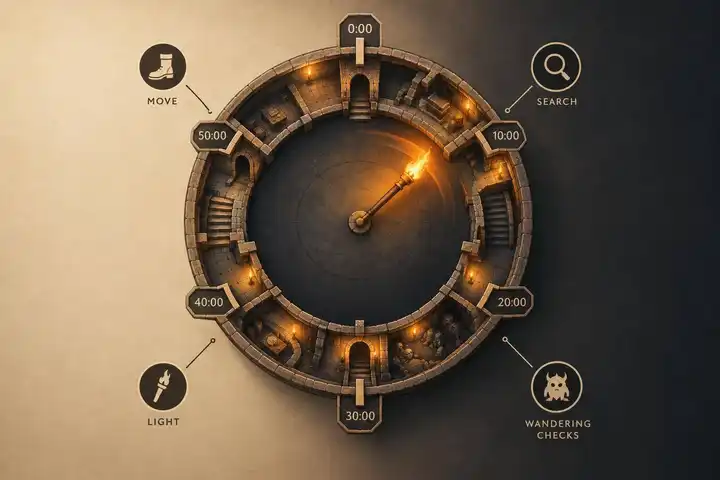
I track dungeon time by meaningful tasks, not footsteps. A turn often lasts 10 in-game minutes, but I use the rulebook’s timing first. I resolve the party’s actions, mark the time, update light and other timers, and roll for encounters when due.
Here’s what I count:
- A full turn: Cautious movement, careful searches, or other sustained tasks - even failed attempts.
- One shared turn: Tasks characters can do at the same time.
- No separate turn: Brief looks, routine interactions, or tracker updates.
With 10-minute turns, a 60-minute torch lasts six turns. If encounter checks fall every two turns, I mark boxes 2, 4, and 6 on a six-box tracker. Noise may draw creatures separately.
My rule of thumb: tell players the time cost before they commit. That keeps attention on what to do next, rather than how many steps they take.

Dungeon Turns: The Exploration Loop and Tracker
The B/X Dungeon Turn on One Index Card - Pacing, Light, Wandering Monsters
What a Dungeon Turn Represents
An exploration turn measures sustained activity, not a combat round. Use your game’s turn length. If it doesn’t specify one, choose a length and tell the table before play. At 10 minutes per turn, six turns equal 1 hour. This clock governs movement, light, and encounter checks.
Decide Which Actions Take a Turn
Charge a turn for cautious movement, thorough searches, listening at a door, checking for traps, forcing or picking difficult doors, and sorting bulky gear or treasure. Agree on the scope before resolving an action: searching a small area isn’t the same as searching an entire room.
Brief observations and routine interactions fit within the current turn. Opening an unlocked door, checking a map, or looking down a visible corridor doesn’t automatically start a new turn. Entering a room doesn’t require a separate turn either, unless your procedure assigns one.
Let Characters Act During the Same Turn
Tasks that can happen at the same time share one turn.
One character can search while another keeps watch.
Count elapsed time, not how many characters act. Tasks performed one after another - or those that require the same tools, space, or attention - may take separate turns.
Tell players the expected time cost before they commit, especially if working faster could mean missing hazards or hidden details. For activities that take more than one turn, track each turn separately. Check in after each so the party can continue, stop, or change tactics. A failed attempt still costs the turn.
Use this same clock in the next step-by-step procedure for movement, light, and encounter checks.
Run the Exploration Turn Step by Step
Use the same turn clock and follow this loop for each exploration turn.
- Describe: Give the area’s size, exits, lighting, sounds, terrain, and obvious hazards. Save hidden features for later checks.
- Ask: Find out the party’s destination, route, and who’s leading.
- Resolve: Handle movement, searching, listening, opening doors, and other declared actions, including any immediate consequences.
- Advance time and update resources: Move the tracker forward, then update light, durations, and other expiring effects.
- Check and describe: Make any scheduled wandering-monster check, then describe what’s changed.
Handle Movement and Searches
Use the game’s exploration movement allowance for the whole move, not each corridor segment. That allowance includes mapping, formation, and ordinary interruptions. A failed search roll still uses the turn; another turn starts only if the party keeps searching.
Track Light and Encounter Checks
Reduce remaining light and temporary-effect durations as turns pass. Track rest, fatigue, food, and water at the intervals your rules call for - not automatically every turn.
Set the wandering-monster schedule before play. One common procedure calls for a check every two turns, with a 1-in-6 encounter chance, regardless of search results.
Noise is a separate trigger. Hammering or forcing a door may draw nearby creatures immediately under the adventure’s rules. Resolve that response apart from the scheduled check. Neither a quiet turn nor a failed search cancels the regular schedule.
Use the table below as a quick reference during play.
Keep an Activity Reference Table
Keep this table beside your tracker and adjust the costs to match your game. Whenever a turn passes, update resources and check whether an encounter roll is due. These updates never cost an extra turn.
| Activity | Normally takes a turn? | GM updates afterward |
|---|---|---|
| Cautious movement | Yes, per exploration allowance | Time; light; durations; scheduled checks |
| Thorough search | Usually | Area searched; findings; time |
| Sustained listening | Usually | Sounds heard; time |
| Difficult door | Usually, if prolonged | Door state; noise; tools; time |
| Quick gear adjustment | No | Gear or formation |
| Scheduled light/encounter update | No | Remaining duration or encounter result |
See 4 Dungeon Turns in Play
Use 10-minute turns, a 60-minute torch, and encounter checks every 2 turns. That gives the party 6 turns of light. Here’s how those turns play out at the table.
Turns 1–2: Search a Room and Follow a Corridor
Turn 1: The party searches its starting room. Resolve the search, including any discovery. The torch has 50 minutes left.
Turn 2: The party follows a corridor cautiously, reaching a junction within its movement allowance. The torch has 40 minutes left. The GM makes the first scheduled encounter check.
The turn cycle stays the same as the party moves from travel to investigation.
Turns 3–4: Listen at a Door and Check a Wall
Turn 3: At the door, one character listens while the others guard. Resolve what the listener hears. The torch has 30 minutes left.
Turn 4: The party searches a suspicious wall for seams, loose stone, and drafts. Resolve the search. The torch has 20 minutes left. The GM makes the second scheduled encounter check.
Conclusion: Track Time and Repeat the Cycle
The procedure follows one repeatable loop. Use the game’s published turn length, and charge a full turn for meaningful exploration tasks - not individual footsteps. Resolve simultaneous tasks within that same turn instead of charging each character separately.
Make a 6-Box Turn Tracker
Draw six boxes and mark one after each completed turn. Flag boxes 2, 4, and 6 for encounter checks.
Beside the boxes, record the turn count, current area, remaining light, effect durations, rest timers, and unfinished tasks. When you begin another row, carry remaining durations forward. A new row doesn’t replenish supplies or reset timers. The grid makes the cycle easy to run at the table.
Repeat the loop: ask, resolve, advance time, update resources, check for encounters on schedule, and describe the result. Follow it whether the party searches a room, moves down a corridor, or listens at a door. Even a failed search costs a turn, and the tracker keeps that cost visible.
FAQs
How do I handle combat during a dungeon turn?
Treat combat as a separate action phase within the dungeon turn. Handle initiative and rounds as usual, but pause exploration bookkeeping - movement, searching, light duration, and wandering-monster checks - until the fight ends.
Resume the dungeon-turn procedure from the party’s new position. Account for spent resources, injuries, and elapsed effects, then decide whether the party keeps exploring or retreats.
What if the party splits up?
Advance dungeon turns for all subgroups at the same time to track time and risk without counting footsteps. If one group spends a turn searching a room while another moves down a corridor, both actions happen during that same turn. Light sources fade at the same rate for everyone, and wandering-monster checks stay consistent across separate locations.
Should backtracking through cleared rooms take full turns?
No. Moving back through cleared rooms shouldn’t cost a full dungeon turn each time. Count the time spent traveling through known space. Charge extra time only if the party searches again, rechecks for hidden hazards, or lingers.
Turns track meaningful progress and exploration - not every footstep.


