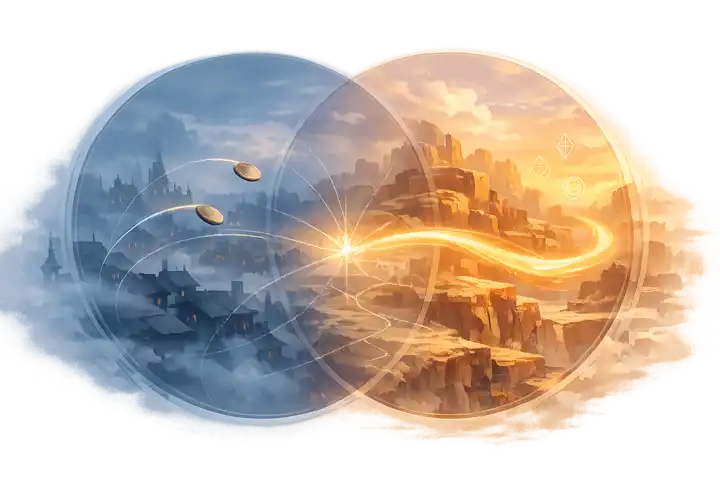
Stormlight Archive and Mistborn are two distinct worlds by Brandon Sanderson, now brought to life through the Plotweaver RPG system. Both settings offer unique gameplay experiences with their own magic systems, storytelling styles, and environments. Here’s a quick breakdown:
- Stormlight Archive (Roshar): Focuses on epic heroism, personal growth, and grand-scale adventures. Players bond with spren, swear Ideals, and harness Surges. Highstorms and Roshar’s alien ecosystem shape gameplay.
- Mistborn (Scadrial): Centers on smaller, tactical stories like heists and political intrigue. Players use Allomancy, Feruchemy, and Hemalurgy. Scadrial evolves from a dark, ash-covered world (Era 1) to a steampunk society (Era 2).
Quick Comparison:
| Feature | Stormlight Archive (Roshar) | Mistborn (Scadrial) |
|---|---|---|
| Primary Hazard | Highstorms, crem buildup | Ashfalls, mists |
| Magic System | Surgebinding, Stormlight recharge | Allomancy, Feruchemy, Hemalurgy |
| Setting Themes | Epic, world-shifting events | Tactical, intimate stakes |
| Tech Level | Magical fabrials | Medieval (Era 1) / Industrial (Era 2) |
Both settings use the same core mechanics, making it easy to combine them in a Worldhopper campaign where characters explore both worlds. The upcoming Worldhopper setting book (September 2026) will expand on this further.

Stormlight Archive vs Mistborn RPG Campaign Comparison
Running Stormlight Archive Campaigns
Roshar: Highstorms and Knights Radiant
Roshar is defined by its Highstorms - massive, destructive weather systems that sweep across the land every 5–6 days at speeds of around 370 mph. Each storm unfolds in three distinct phases: the devastating Storm Wall, the chaotic Main Body, and the calmer Riddens.
"Highstorms: the deadly world-altering storms that shape every corner of Roshar, affecting all aspects of life... No Stormlight RPG campaign would be complete without a storm or two to mix things up for the adventuring party." - Tom, Writer, Invested in the Cosmere
The geography of Roshar plays a big role in how these storms affect different regions. The eastern areas, like Alethkar and the Shattered Plains, take the brunt of the Highstorms, while western regions like Shinovar experience much weaker effects, reduced to heavy rain. You can use natural storm shelters, called laits, in your campaigns - these are valleys or hills that provide protection from the storm's fury. Cities also reflect the storms’ east-to-west pattern, with thick, windowless eastern walls and open western-facing windows.
Roshar’s unique environmental conditions add even more depth to gameplay. With a surface gravity of 0.7 standard and higher oxygen levels, characters can jump farther and fall more slowly. This also makes the existence of massive creatures like Chasmfiends more plausible. Another interesting feature is the Weeping, a four-week stretch of constant, mild rain that provides a safer time for travel or strategic maneuvers.
These environmental factors create a dynamic backdrop for exploring Roshar's intricate magic system, which takes center stage in the next section.
Magic Systems: Surges, Spren, and Radiant Oaths
Magic in Stormlight campaigns revolves around the Nahel bond - a connection between a human and a spren that unlocks access to Surges, the fundamental forces of Roshar. Instead of relying on experience points, characters progress by swearing new Ideals at key story moments. The First Ideal ("Life before death. Strength before weakness. Journey before destination.") is universal, while later Ideals are specific to each Radiant Order. These milestones often come with significant power boosts, such as gaining Shardblades at the Third Ideal and Shardplate at the Fourth.
Surgebinding abilities are tied to Stormlight, which characters recharge by storing gemstone spheres during Highstorms. This introduces a risk-reward element, as players must decide when and where to expose themselves to the storm's power. Additionally, bonded spren can act as active participants in the story, offering advice, warnings, or even moral dilemmas, adding depth to the narrative.
For orders like the Dustbringers, gameplay can include "Discipline" skill checks to reflect their struggle to control destructive power. One example, shared by Tom from Invested in the Cosmere, involves a Dustbringer character tasked with burning diseased crops. Success means a controlled burn, while failure could lead to unintended destruction.
This magic system naturally encourages a variety of character archetypes and story possibilities.
Character Types and Story Ideas
Each of the ten Radiant Orders offers a distinct style of play. Windrunners, for example, use Gravitation and Adhesion Surges to excel in mobility and defense. Lightweavers are often spies or artists, with their progression tied to revealing personal truths. This mechanic encourages players to define a secret for their character at the start of the campaign. Dustbringers, on the other hand, are disciplined individuals who walk a fine line between control and destruction.
"The Dustbringers believe that great power requires a strong will to control it, and their oaths are designed to teach them to control their destructive power." - Coppermind, Order of the Dustbringers
To keep party dynamics balanced, you can introduce the Squire system. Squires gain limited Surgebinding abilities through their bond with a full Radiant but lose these powers if they stray too far - typically 30 to 50 miles - from their mentor.
When designing your campaign, consider setting it in an era that matches your story goals. A Way of Kings-era campaign works well for intrigue and mystery, as Radiants are still largely unknown. A Words of Radiance-era setting is better for stories about growing power and discovery. For high-level play, an Oathbringer or Rhythm of War-era backdrop allows for global travel via Oathgates and the use of advanced fabrial technology.
First Impression of Cosmere (The Stormlight & Mistborn TTRPG)
Running Mistborn Campaigns
Mistborn campaigns immerse players in the world of Scadrial, a land shrouded in ash and mists, where sharp class divides and moral complexities dominate. Unlike the storm-driven chaos of Roshar, Scadrial thrives on themes of rebellion, secrecy, and difficult choices. This backdrop allows for a wide range of stories, from dark fantasy heists to detective tales set in an industrial age.
Scadrial: A World of Ash and Mists
Scadrial’s defining features include its ever-present ashfalls and nightly mists. The ash creates a stark visual contrast between the noble class, who remain immaculately clean, and the skaa, whose soot-streaked appearances reflect their oppression. The mists, meanwhile, carry an air of mystery, hiding dangers like the eerie mistwraiths that consume the dead.
The tone of the campaign shifts depending on the era. Era 1 delves into dark fantasy, focusing on rebellion against the Lord Ruler and the heists of a "thieving crew." This era is steeped in medieval technology and features 10 basic metals. Era 2, on the other hand, introduces a world of industrial progress, complete with firearms, railways, skyscrapers, and the expanded use of all 16 metals.
"Mistborn Era One offers a dark fantasy world of heists, horror, rebellion, and ballroom intrigue. Era Two adds pulp adventure, detective stories, secret societies, and gunslinging action." - Cosmere RPG
A creative way to tie both eras together is through a "Legacy" campaign, where players control two groups - one in Era 1 and another in Era 2. Actions taken by the earlier group directly shape the world of the later era, creating a dynamic and interconnected narrative.
Magic Systems: Allomancy, Feruchemy, and Hemalurgy
Magic plays a central role in Mistborn campaigns, offering tactical depth and narrative opportunities. Scadrial's magic systems are rooted in strict rules, which ensures both balance and creativity. The upcoming Cosmere RPG expands on this with 34 metallic art paths.
Allomancy is based on burning ingested metals to gain temporary powers. It features 16 core abilities divided into categories like Physical, Mental, Enhancement, and Temporal. Rare metals like Atium add a layer of resource management, as they burn quickly and are expensive.
"No metal, no Allomancy. Simple as that." - C. R. Rowenson, The Magic Engineer
The mechanics of Allomancy are grounded in physics. For example, steelpushing and ironpulling depend on the relative weight of the user and the object. If the object is heavier, the user moves instead. Weight Classes, ranging from Floatweight (0–24 lbs) to Immovable (1,000+ lbs), help determine outcomes. To simplify resource tracking, a Fate Point system can reward players when they run low on metals during key moments. In D&D 5e adaptations, projectile attacks using Allomancy often deal 1d8 damage plus an ability modifier.
Feruchemy allows users to store personal attributes in metalminds for later use. This creates a trade-off, as characters must endure temporary weakness to gain future strength. Recovery mechanics, such as "Breathers" (short rest periods), help manage this system effectively.
Hemalurgy involves transferring powers between individuals using metal spikes. This system introduces horror elements and moral dilemmas, as it often comes at a steep ethical cost. In the Cosmere RPG, Hemalurgy is presented as a rare reward rather than a standard path.
| Magic System | Power Source | Key Mechanic | Balance Factor |
|---|---|---|---|
| Allomancy | Burning ingested metals | External/renewable | Metal rarity and burn rate |
| Feruchemy | Storing personal attributes | Internal storage/tapping | Temporary weakness for later strength |
| Hemalurgy | Stealing power via spikes | Transference between individuals | Moral cost and corruption |
Character Types and Story Ideas
Mistborn characters fall into two main categories: Mistborn, who can burn all metals, and Mistings, who specialize in just one. In RPG terms, Era 1 characters typically advance from levels 1–6, while Era 2 campaigns often start players at level 3.
Feruchemists, also known as Keepers, are Terrismen who store attributes like strength or memories in metalminds. They often serve as guardians of forbidden knowledge and religions. In Era 2, Twinborn characters - those with one Allomantic and one Feruchemical ability - add interesting mechanical combinations. The RPG also introduces new archetypes like the Mastermind (leader/infiltrator), Gunslinger (Era 2 combatant), and Brawler.
Non-human options expand the possibilities further. Kandra, shapeshifters bound by contracts, and Koloss-blooded, a marginalized group with unique lore, offer rich storytelling opportunities. Instead of a traditional adventuring party, players might form a "Crew", with a shared goal like theft, political upheaval, or rebellion. Each character can be driven by a personal Destiny and a past Tragedy, adding depth to their motivations.
Era 1 campaigns often revolve around high-stakes heists, the fight against the Lord Ruler, and navigating the intrigues of noble houses. For skaa characters, hiding their powers to avoid execution adds tension. Era 2 campaigns, meanwhile, can explore themes like frontier justice, detective work, and secret society conspiracies, such as those involving "The Set".
"A skilled Allomancer will always beat an instinctive Allomancer. That's a huge part of the story." - C. R. Rowenson, The Magic Engineer
When using emotional magic like "Soothing" or "Rioting", it’s best to treat these abilities as subtle influences rather than direct control, ensuring players retain their agency. For D&D-style adaptations, consider allowing "Misting Talents" to be swapped during long rests, simulating shifts in body chemistry. With its focus on personal stakes and tough moral choices, a Mistborn campaign promises rich, character-driven storytelling.
Stormlight vs Mistborn: Direct Comparison
Worldbuilding: Roshar vs Scadrial
Roshar and Scadrial each present unique environmental challenges that can shape the tone and design of campaigns. Roshar is defined by its relentless highstorms - massive storms traveling at 370 mph every 5–6 days - leaving behind crem deposits and supporting an alien ecosystem filled with armored creatures and retracting plants. The planet's unusual gravity and oxygen levels even allow for colossal creatures like chasmfiends, towering six times the height of a human.
"A protective carapace is necessary for survival in such a harsh environment." - Christopher Hutton
Scadrial, on the other hand, is shaped by its ash-covered skies and lack of sunlight. In Era 1, it’s a bleak, sunless land ruled by a thousand-year autocracy, while Era 2 shifts into a steampunk-inspired industrial setting with firearms and evolving technology. The environmental dangers on Scadrial are tied more to resource scarcity and societal struggles than to natural disasters.
Social structures also differ significantly. Roshar is steeped in a rigid caste system, dividing lighteyes and darkeyes, with military traditions and religious Oaths playing central roles. Scadrial transitions from the oppressive noble-skaa divide of the Final Empire to a more industrialized society with an emphasis on law, order, and secretive organizations. Roshar is home to both humans and the native "singers", while Scadrial features unique beings like the shapeshifting Kandra and the powerful koloss.
| Feature | Roshar (Stormlight Archive) | Scadrial (Mistborn) |
|---|---|---|
| Primary Hazard | Highstorms (wind, rain, and crem) | Ashfalls and the mists |
| Ecology | Crustaceans, spren, retracting flora | Bleak (Era 1) / Earth-like (Era 2) |
| Gravity/Atmosphere | 0.7 gravity, high oxygen levels | Standard conditions |
| Social Structure | Lighteyes vs. Darkeyes caste system | Noble vs. skaa (Era 1) / emerging industrial order (Era 2) |
| Technology Level | Magical fabrials | Medieval (Era 1) / Industrial with firearms (Era 2) |
For game masters, Roshar's highstorms can act as a "ticking clock", creating urgency in travel and serving as a key way to recharge magical resources. On Scadrial, the scarcity of specific metals forces players to make strategic decisions, balancing utility and combat needs. These contrasting worlds not only bring unique hazards but also feature magic systems that define gameplay in distinct ways.
Magic Systems and Game Mechanics
The magic systems of Stormlight and Mistborn differ in both mechanics and strategy, offering players distinct challenges. Surgebinding in Stormlight relies on Stormlight, an energy stored in infused gemstones and replenished by highstorms. This cyclical resource encourages players to plan their actions around the storm schedule. By contrast, Mistborn's Allomancy depends on the consumption and burning of specific metals, offering consistent effects but requiring careful resource management.
Surgebinding features around eight distinct abilities per Radiant path, spread across ten Orders of Knights Radiant. Allomancy, on the other hand, offers about six abilities per metallic path, with 34 different arts in total. Radiants often specialize deeply within their chosen Order, while Mistborn characters develop broader capabilities across multiple paths, and mistings focus solely on one metal.
Progression also varies. Surgebinders grow more powerful by swearing Oaths and Ideals, which reflect their personal growth and principles. Allomancy follows a more traditional skill tree, rewarding creative uses of physics and strategy.
| Feature | Surgebinding (Stormlight) | Allomancy (Mistborn) |
|---|---|---|
| Primary Resource | Stormlight from infused gems | Consumable metals |
| Path Depth | ~8 talents per Radiant path | ~6 talents per metallic art path |
| Progression | Swearing Oaths and Ideals | Talent tree advancement |
| Reliability | High, requiring active bond and intent | Extremely consistent in its effects |
| Character Focus | Knights Radiant and their Orders | Mistings, Mistborn, and Twinborn |
Balancing mixed parties can be challenging. Mistborn characters often progress more slowly in their talent trees compared to the highly specialized mistings or Radiants. Game masters can use highstorms to temporarily "recharge" Radiant characters with Stormlight, creating dynamic shifts in power and strategy.
Themes and Story Styles
The narrative tone of each setting also shapes the storytelling experience. Stormlight campaigns often revolve around themes of epic heroism, redemption, and personal growth, with players swearing Oaths and pursuing Ideals. These stories frequently include small, intimate moments - like personal habits or quiet character interactions - that build emotional depth before escalating into large-scale conflicts and political intrigue.
"A true Stormlight Archive tabletop RPG developed with Sanderson's worldbuilding philosophy at its heart would be a beautifully mundane breath of fresh air." - Christopher Hutton
Mistborn campaigns, in contrast, lean heavily into heist and rebellion plots during Era 1 or industrial-age mysteries and Wild West justice in Era 2. The official Mistborn RPG is particularly noted for its darker tones, with hemalurgic spikes adding a layer of horror. These elements open the door to morally complex stories, often driven by resource scarcity and ethical dilemmas.
Game masters can blend these styles by using interludes to explore world-building scenes parallel to the main narrative. In Mistborn campaigns, dual-era play - where one party operates in Era 1 and another in Era 2 - can showcase the long-term consequences of players' actions, creating a campaign that’s 50% longer than the Stormlight "Stonewalkers" campaign. Both settings also utilize a plot die mechanic, allowing players to introduce opportunities or complications, encouraging collaborative storytelling.
This contrast in narrative styles offers game masters the flexibility to merge Stormlight's grand, heroic arcs with Mistborn's intrigue and morally gray storytelling, resulting in campaigns that highlight the best of both worlds.
Combining Elements from Both Series
The Cosmere RPG's Plotweaver system ties everything together with consistent mechanics across all settings. At its core is Investiture, the shared energy source for all magic systems. While Surges and Metallic Arts might look different, they both stem from the same Investiture foundation. This setup makes it easier for characters to grow and adapt across the various worlds.
"The base is the same; you still have the plot die, the action system, and the narrative elements. It all meshes well." - Ruvaid Virk, Writer and Game Designer, Brotherwise Games
Instead of rigid classes, character progression uses multi-pathing, allowing players to mix heroic paths like Scholar or Warrior with supernatural ones such as Radiant or Allomancer. For example, a character might begin as a Windrunner on Roshar and later gain Tin Allomancy after traveling to Scadrial. Hemalurgy acts as another link between magic systems. Hemalurgic spikes, treated as rewards, let characters tap into powers from entirely different worlds. This adaptability makes cross-world character development feel seamless and natural.
The Cognitive Realm (Shadesmar) serves as the narrative gateway for worldhopping campaigns. Organizations like the Ghostbloods, which operate across the Cosmere, provide built-in plot hooks for players. To keep things balanced, Mistborn characters can develop as generalists but with slower progression in individual metals, while Mistings and Radiants can specialize deeply. Players can also use Rosharan fabrials to interact with Scadrian magic. For instance, an Alerter fabrial (priced at $500) can be configured to detect Allomancers or people carrying Hemalurgic spikes.
"The Cosmere RPG offers a versatile system designed for standalone stories within the Stormlight™ or Mistborn® settings, or for epic Worldhopper™ campaigns traversing multiple realms." - Tayan Hatch, Marketing Coordinator, Dragonsteel
Looking ahead, the system is set to grow even more. A Worldhopper setting book is scheduled for release in September 2026, providing detailed mechanics for traveling between planets and integrating characters from different settings. Until then, the current rules give players enough tools to experiment with mixed-world adventures, all while preserving the distinct elements of each series.
Conclusion
Deciding between a Stormlight or Mistborn campaign comes down to what your group values most. Stormlight offers a rich, otherworldly experience with a magic system tied to character development and moral oaths. On the other hand, Mistborn presents a more grounded setting with a structured, physics-driven magic system - perfect for heists and tightly focused, personal stories.
The two settings also work well together. Both use the d20-based Plotweaver system, making it easy to combine elements from each. For seasoned players, a Worldhopper campaign could be an exciting option, allowing characters to journey between Roshar and Scadrial. Plus, the Worldhopper setting book, scheduled for release in September 2026, promises even more possibilities.
FAQs
Which setting is better for new GMs?
The Stormlight Archive tends to be a better starting point for new GMs because of its detailed worldbuilding and well-defined setting. These elements offer plenty of inspiration and a solid framework for crafting campaigns. The series’ rich cultures and intricate magic system naturally lend themselves to creating compelling stories without requiring a lot of upfront effort.
On the other hand, Mistborn can be a bit trickier for beginners. While it offers flexibility, it leans heavily on its unique mechanics and character-focused themes, which might demand a deeper understanding and more preparation to run effectively.
How do you balance Radiants and Allomancers in one party?
Balancing Radiants and Allomancers comes down to understanding how their unique abilities complement each other. Radiants, such as Windrunners, shine in areas like protection and mobility, while Allomancers bring a broad spectrum of offensive and utility skills to the table.
To create harmony between the two, it’s key to assign distinct roles that play to their strengths. Radiants can dominate the battlefield by shielding allies and controlling movement, giving Allomancers the space to unleash their metal-fueled powers with precision. When tactics are coordinated effectively, both groups can amplify each other's potential, turning their differences into a powerful synergy.
What’s the easiest way to start a Worldhopper campaign?
If you're looking to kick off a Worldhopper campaign in the Cosmere, the simplest approach is to choose one world to focus on - like Roshar or Scadrial. Dive into its lore, explore its unique magic systems, and get a good grasp of its standout features. To help with mechanics and character creation, rely on fan-made rulebooks and community-driven resources.
Begin with a tight, well-defined storyline. Incorporate some of the world's signature elements, such as highstorms on Roshar or Allomancy on Scadrial, to make the setting come alive for your players. This way, you'll create an engaging and immersive experience without overwhelming yourself or the group.


