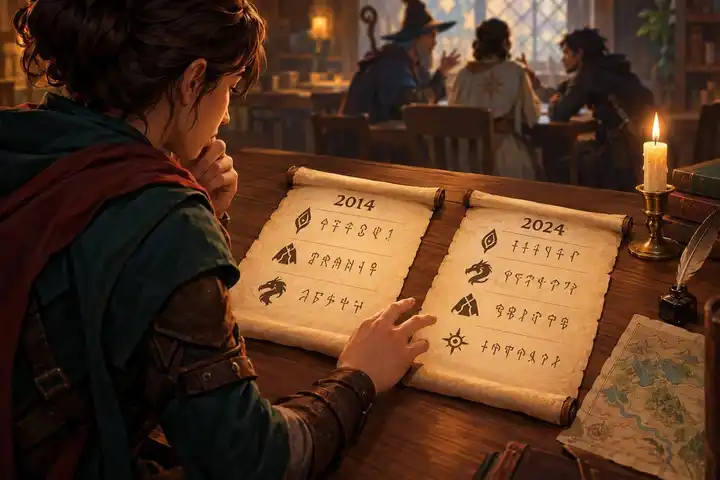
I’d pick languages your DM expects NPCs to speak - not just ones that sound interesting. Start by checking your rules: 2014 languages come from race and background; 2024 characters get Common plus 2 Standard languages.
My next step is matching choices to the campaign: Draconic for dragons, Undercommon for Underdark travel, Infernal for devils, or local languages for everyday talks. For party roles, I’d match the face to local leaders, pair scouts with an ally who knows Common Sign Language, and choose lore languages for recurring threats.
Quick Comparison
| Starting-language rule | 2014 | 2024 |
|---|---|---|
| Starting source | Race and background | Common plus 2 Standard languages |
| Draconic | Exotic | Standard |
| Common Sign Language | Not on the core language lists | Standard |
| Restricted choices | Exotic and secret languages need permission or a granting feature | Rare languages need a granting feature or DM-approved access |
My rule of thumb: check access before choosing. Druidic and Thieves’ Cant need a feature or other permitted source, and knowing a language doesn’t guarantee trust, solve a cipher, or explain local customs.

D&D Language Choices: 2014 vs. 2024
2014 vs. 2024: How Starting Languages Work
2014: Languages From Race and Background
Under the 2014 rules, your character’s race usually provides default languages. Some backgrounds also grant one or more languages of your choice. When either gives you a choice, select from the Standard Languages list or a campaign language your DM allows.
The table below separates regular choices from languages that need special access.
| Ruleset | Category | Languages | Typical speakers or uses | Access and DM permission |
|---|---|---|---|---|
| 2014 | Common | Common | Widely spoken by humans | Usually provided by race |
| 2014 | Standard languages | Dwarvish, Elvish, Giant, Gnomish, Goblin, Halfling, Orc | Dwarves, elves, giants and ogres, gnomes, goblinoids, halflings, orcs | Available when your race or background grants a language choice |
| 2014 | Exotic | Abyssal, Celestial, Deep Speech, Draconic, Infernal, Primordial, Sylvan, Undercommon | Demons, celestials, aberrations, dragons and dragonborn, devils, elementals, fey, Underdark communities | Usually requires DM permission unless a feature grants it |
| 2014 | Secret | Druidic, Thieves’ Cant | Druids; covert communication among thieves | Granted by relevant features or DM permission |
| 2024 | Standard | Common, Common Sign Language, Draconic, Dwarvish, Elvish, Giant, Gnomish, Goblin, Halfling, Orc | General communication, signing, dragons, and communities across the setting | Common is automatic; choose or roll two additional languages from this table |
| 2024 | Rare | Abyssal, Celestial, Deep Speech, Druidic, Infernal, Primordial, Sylvan, Thieves’ Cant, Undercommon | Planar beings, aberrations, druids, fey, thieves, and Underdark groups | Outside the normal two-language selection unless a feature or DM-approved exception applies |
A language choice doesn’t give you free access to every language. In 2014, exotic languages still need access through a race, background, or feature.
2024: Common Plus 2 Standard Languages
Under the 2024 rules, every character starts with Common plus two additional languages, chosen or rolled from the Standard Languages table. Draconic moves to the Standard list, which also adds Common Sign Language.
For a campaign-specific build, choose rather than roll so you can pick languages you expect to use with the NPCs you’ll meet. Match those choices to your character’s role, too. Infernal and Undercommon sit outside the normal selection: you’ll need a feature or a DM-approved exception to get them.
Every D&D Language Explained
Language Categories: Uses and Limits
Once you know how languages are assigned, consider which ones your party will use. Categories affect access, not value. Choose languages based on campaign needs, not rarity alone.
Infernal suits a devil-focused campaign; Elvish suits an elf-dominated region.
Standard Languages for Local Communities
Match your choices to the communities, records, and ruins your party expects to encounter.
Elvish helps with elven communities, poetry, history, maps, and inscriptions; Dwarvish with dwarven settlements, clan records, engineering, and forge-related sites; Gnomish with gnomish workshops and technical writings; and Halfling with halfling communities and local trade. Goblin, Orc, and Giant are useful around their respective peoples, border conflicts, giant-ruled ruins, and monumental inscriptions.
Common Sign Language uses visible hand signs. It helps in noisy or covert scenes, but characters must be able to see each other.
Broadly useful languages support local communication. Rare languages become useful when an adventure centers on a particular faction, creature type, or region.
Exotic and Rare Languages for Specific Adventures
Languages outside the normal starting list usually need access through a class, background, feat, or the DM. Druidic and Thieves’ Cant are tied to class features rather than ordinary language choices.
| Language | Adventure uses | 2014 category and access | 2024 category and access |
|---|---|---|---|
| Abyssal | Demons, Abyssal cults, and demonic inscriptions | Exotic; special access | Rare; special access |
| Celestial | Angels, divine agents, temples, prophecies, and celestial relics | Exotic; special access | Rare; special access |
| Deep Speech | Aberrations, alien ruins, and psychic mysteries | Exotic; special access | Rare; special access |
| Druidic | Druids, nature enclaves, and hidden warnings | Secret; druid feature | Rare; specific features or supported options |
| Infernal | Devils, contracts, infernal bureaucracy, and Nine Hells lore | Exotic; special access | Rare; special access |
| Primordial | Elementals, elemental temples, portals, and inscriptions | Exotic; special access | Rare; special access |
| Sylvan | Fey courts, dryads, sprites, enchanted forests, and fey bargains | Exotic; special access | Rare; special access |
| Thieves’ Cant | Criminal contacts, coded messages, and underworld networks | Secret; rogue feature | Rare; specific features or supported options |
| Undercommon | Drow, duergar, Underdark traders, and subterranean travel | Exotic; special access | Rare; special access |
| Draconic | Dragons, dragonborn, kobolds, draconic cults, and ancient inscriptions | Exotic; special access | Standard; normal starting choice |
Rare or exotic languages usually need a feature, background, feat, or DM-approved source. These adventure uses are examples, not guarantees. Check your character’s options and campaign rules before choosing.
A language enables communication, not trust. It won’t give you passwords, knowledge of local customs, or protection from a deceptive bargain. Damaged text, ciphers, magical concealment, and unfamiliar archaic wording may still need investigation. These limits help you narrow your choices by campaign role.
The next filter is your character’s job in the party.
Choose Languages by Role and Campaign
Once access is clear, choose languages that fit your party’s roles and the regions your campaign will use.
Languages for Dragons, the Underdark, and Devils
Choose Draconic for recurring dragon negotiations, research, or inscriptions. Pick Undercommon for extended Underdark travel and trade, Infernal for devils, and Abyssal for demons.
Languages for Party Faces, Scouts, and Spies
Give the party face the language local decision-makers use. For stealth-heavy play under the 2024 rules, give Common Sign Language to the scout and one ally. Both must be able to see each other to communicate.
For criminal work, count on Thieves’ Cant only if a feature grants it. Its coded speech and signs help characters conceal messages and connect with underworld contacts. Cover more languages when characters gather information independently, but make sure allies share a language when they need to coordinate.
Languages for Arcane, Divine, and Nature Characters
Match lore languages to threats that appear often in your campaign: Draconic for dragon lore, Deep Speech for aberrations, and Primordial for elemental matters.
Choose Celestial for divine texts and emissaries, or Sylvan for fey dealings. Druidic requires a feature that grants it and serves druid-circle communication; it isn’t a default choice for every nature-focused character.
Conclusion: Check Rules, Access, and Campaign Needs
Under the 2014 rules, starting languages come from race and background. Under the 2024 rules, every character gets Common plus two Standard languages. Draconic is Standard in 2024, while Rare languages require special access.
Confirm which ruleset you're using, then check access to each language through rules, features, or DM approval. Pick languages your character will use in the campaign’s recurring locations, factions, and encounters.
FAQs
Can I learn new languages after character creation?
Yes, you can learn new languages after character creation. You choose your starting languages when you create your character, but you can learn more as your character progresses. Ask your Dungeon Master how learning additional languages works in your campaign and how those opportunities might fit into the story.
How do I update my 2014 character’s languages for 2024?
Check the 2024 Player’s Handbook for the languages your chosen background or species grants. Replace your 2014 racial language proficiencies with those listed for your 2024 background. This follows the shift of ability score increases and proficiencies to backgrounds.
Review these changes with your Game Master to make sure they stay balanced for your campaign.
Should our party choose different languages or share them?
Coordinate language choices so your party can speak several languages instead of depending on one translator. Talk with the Dungeon Master about the campaign, then pick languages that fit your likely adventures: Draconic for dragons, Undercommon for the Underdark, or Infernal for dealing with devils. A mix of languages gives your group more ways to handle social encounters and investigations.


