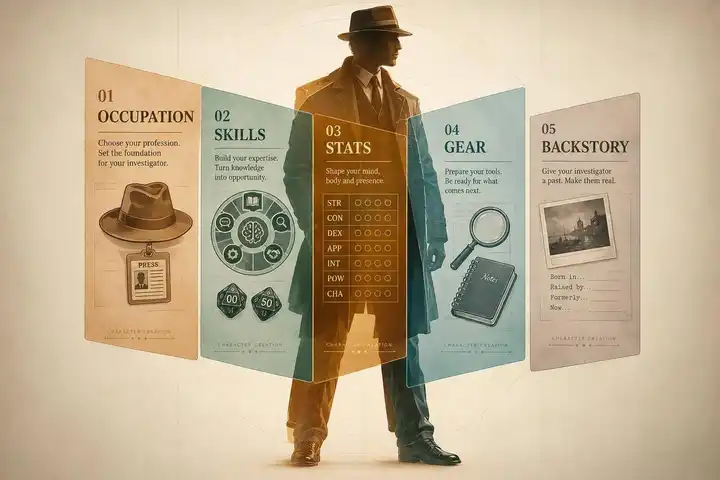
To build your first Call of Cthulhu 7th Edition investigator, I recommend checking the Keeper’s rules before rolling your eight characteristics and Luck. Apply age changes before spending skill points.
Here’s the path I follow:
- Choose an occupation: Set your work skills and Credit Rating range.
- Spend two separate point pools: Use your occupation’s formula for professional skills and INT × 2 for personal interests.
- Finish the numbers: Calculate health, Sanity, Magic Points, Damage Bonus, Build, movement, and skill thresholds.
- Add gear and a reason to investigate: Match equipment to your funds and give the Keeper a contact or lead to use.
I’ll walk through a journalist with 280 occupational points and 140 personal-interest points, then check the finished sheet. My final step: get the Keeper’s approval before play.

Call of Cthulhu 7e Character Creation Flowchart
Choose an Occupation and Assign Skill Points
Compare Occupations and Skills
Choose an occupation that explains why your investigator is on the case. It sets their professional skills, Credit Rating range, financial standing, and useful contacts.
| Occupation | Occupational point formula | Key occupational skills | Credit Rating range | Strengths or trade-offs |
|---|---|---|---|---|
| Antiquarian | EDU × 4 |
Appraise, History, Library Use, Other Language | 30–70 | Strong research skills, weak in combat |
| Police Detective | (EDU × 2) + (STR × 2 or DEX × 2) |
Firearms, Law, Psychology, Spot Hidden | 20–50 | Social and physical skills, legal constraints |
| Journalist | EDU × 4 |
Art/Craft (Photography), Library Use, Persuade, Psychology | 9–30 | Focus on information, limited cash |
| Professor | EDU × 4 |
Library Use, Other Language, Own Language, Psychology | 20–70 | Specialized knowledge, limited field experience |
| Private Investigator | (EDU × 2) + (STR × 2 or DEX × 2) |
Law, Library Use, Psychology, Spot Hidden | 9–30 | Broad skill set and independence, limited cash |
Use these differences to match the occupation to your investigator’s role and starting resources.
Spend Occupational Points and Set Credit Rating
Once you’ve chosen an occupation, spend its points. Keep occupational points in a separate tally.
A journalist with EDU 70 receives
70 × 4 = 280points.
Spend these points only on the occupation’s listed skills and Credit Rating. Record the points you spend, not the final skill totals, then add them to each skill’s existing base value.
Credit Rating measures spending power and status. Set it within your occupation’s range, and deduct the points spent from your occupational pool.
Spend Personal-Interest Points
Next, round out your investigator with personal-interest points. Calculate this separate pool using INT × 2.
INT 70 gives 140 points.
Spend these points on occupational skills or other investigation skills, a safety skill such as First Aid or Climb, and gaps in your investigator’s abilities. Record each pool’s contribution separately.
Cthulhu Mythos starts at 0% and cannot receive character-creation points without Keeper permission.
Call of Cthulhu 7E Character Generation (Standard Rules)
Calculate Derived Values and Choose Equipment
With skill points assigned, fill in the numbers that help your investigator survive, then choose their equipment.
Record Hit Points, Sanity, Magic Points, and Luck
Use your final characteristic scores, round Hit Points down, and enter the Luck score you rolled separately. These values track how well your investigator handles fear, injury, and pressure.
| Statistic | Formula | Result: CON 50, SIZ 60, POW 60, Luck 50 | Where to record it |
|---|---|---|---|
| Hit Points | floor((CON + SIZ) / 10) |
11 | Hit Points section |
| Starting Sanity | POW |
60 | Current Sanity |
| Magic Points | POW / 5 |
12 | Magic Points section |
| Luck | Separately rolled score | 50 | Luck section |
| Maximum Sanity | 99 − Cthulhu Mythos |
99 with Cthulhu Mythos 0 | Maximum Sanity |
Calculate Damage Bonus, Build, and Movement
Add STR + SIZ, then look up the total in the 7th Edition Damage Bonus and Build table. Enter both results in their labeled fields. For MOV, compare STR and DEX with SIZ, then apply any age adjustments.
For the example journalist, STR 45 + SIZ 60 = 105: record Damage Bonus 0 and Build 0. DEX 60 equals SIZ 60, while STR is lower, so record MOV 8.
Set Starting Wealth and Choose Gear
Use Credit Rating and the campaign era to determine starting cash and assets. Check purchases with the Keeper to make sure they fit the setting.
For a 1920s U.S. journalist, practical gear includes press credentials, a notebook, pencils, and telephone access.
Choose gear that fits the investigator’s role and the challenges likely to come up in the first session. Use the calculated values as the baseline for the completed journalist example below.
Complete the Journalist Example
Link the Backstory to the Investigation
Connect the journalist to the case through one source, one place, and one contact the Keeper can use in the opening scene.
A dockworker’s tip leads the journalist to a warehouse linked to the disappearances, where another investigator’s police contact can help them gain access.
Finish the Sheet and Check Skill Spending
This journalist focuses on interviews, research, and field reporting. Record these values for the worked example:
STR 45, CON 50, SIZ 60, DEX 60, APP 55, INT 70, POW 60, EDU 70, plus Luck 50.
Derived values: HP 11, MP 12, Damage Bonus 0, Build 0, and MOV 8.
Transfer the finished numbers to the character sheet. Use the table to check the 280 occupational points and 140 personal-interest points spent.
Skill Base Occupational Personal-interest Final Half Fifth Art/Craft (Photography) 5 45 0 50 25 10 History 5 40 0 45 22 9 Library Use 20 40 0 60 30 12 Language (Own: English) 70 10 0 80 40 16 Persuade 10 40 0 50 25 10 Psychology 10 35 0 45 22 9 Language (Other: French) 1 30 0 31 15 6 Art/Craft (Writing) 5 20 0 25 12 5 Credit Rating 0 20 0 20 10 4 Spot Hidden 25 0 40 65 32 13 Listen 20 0 30 50 25 10 Stealth 20 0 30 50 25 10 Drive Auto 20 0 20 40 20 8 Firearms (Handgun) 20 0 20 40 20 8 Points spent - 280 140 - - -
Credit Rating 20 sits within the standard journalist range of 9–30. Use that rating to support the final gear list:
Speed Graphic camera, 12 flashbulbs, press pass, leather notebook, fountain pen, and a concealed .38 revolver.
Conclusion: Prepare for Your First Session
Your investigator is ready when the numbers support the role you’ll play and the backstory gives you a reason to join the case.
Check the Sheet Before Play
Double-check your characteristics, occupation, Credit Rating, both skill-point totals, HP, Sanity, MP, and Luck.
Before play starts, get the Keeper’s approval on your finished sheet, what draws you into the case, and why you’ll work with the group.
FAQs
How do I roll my investigator’s characteristics?
In Call of Cthulhu 7th Edition, you roll dice to set your investigator’s eight base characteristics: Strength, Constitution, Power, Dexterity, Appearance, Intelligence, Size, and Education.
These traits shape your character and affect how you handle challenges. They also help determine derived statistics, such as hit points, sanity, and magic points.
How does age affect my investigator’s stats?
The provided search results don’t explain how age affects an investigator’s stats in Call of Cthulhu 7th Edition.
Which skills should I prioritize as a beginner?
Choose skills that fit your investigator’s occupation, upbringing, and personal history - and help you gather information and solve mysteries. Library Use helps with research, while Persuasion or Intimidation can draw clues out of conversations with non-player characters.
Skills such as Archaeology, Occultism, or Science provide specialized knowledge to help you understand threats. Let your investigator’s backstory and motivations guide those choices.


