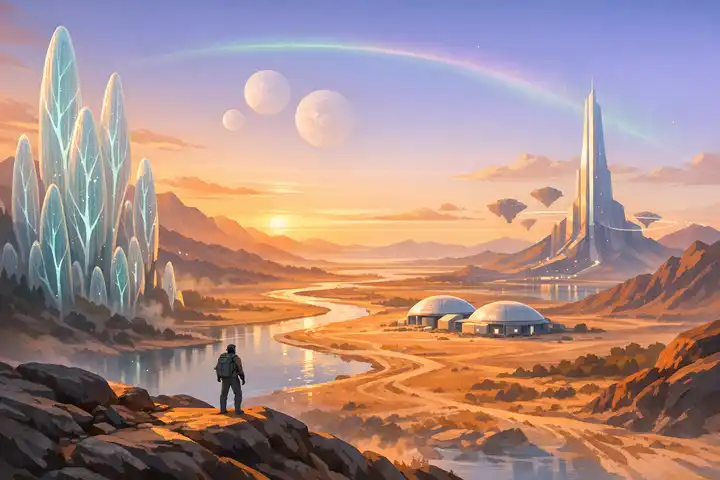
Looking for sci-fi RPGs with immersive alien worlds? Here's a quick breakdown of standout games that excel in creating rich, alien environments:
- Alien: The RPG: Survival horror set in the Alien universe. Features stress mechanics, corporate intrigue, and deadly Xenomorphs.
- Alternity: A flexible system for building your own alien species and worlds, offering endless customization.
- Classic Traveller: Procedural tools for generating star systems and alien societies, rooted in 1970s hard sci-fi.
- Stars Without Number: Sandbox-style worldbuilding with tools for creating planets, factions, and alien cultures.
- Eclipse Phase: A transhumanist RPG exploring identity, post-apocalyptic futures, and cosmic horror.
- Mothership: Fast-paced space horror with a focus on survival, stress, and high-stakes gameplay.
Quick Comparison
| Game | Focus | Mechanics | Alien Worldbuilding | Tone |
|---|---|---|---|---|
| Alien: The RPG | Survival horror | Stress/Panic Dice | Gritty and hostile | Claustrophobic |
| Alternity | Custom species/worlds | Point-based creation | Build-your-own alien cultures | Open-ended |
| Classic Traveller | Hard sci-fi realism | Procedural generation | Major/Minor alien races | Expansive |
| Stars Without Number | Sandbox exploration | World Tags/Factions | Dynamic alien societies | Player-driven |
| Eclipse Phase | Transhumanism | Resleeving/Infection | Cosmic horror and alien threats | Philosophical |
| Mothership | Space horror | Stress/Panic Engine | Minimalist, eerie settings | Intense survival |
Whether you prefer detailed sandbox creation, survival horror, or philosophical sci-fi, there's a game for you. Dive into the full article for more details on each system!

Sci-Fi RPG Comparison: Alien Worldbuilding Mechanics and Features
Building Your Science Fiction Setting | The Way of Worldbuilding
Alien: The RPG
Free League Publishing's Alien: The Roleplaying Game took home the 2020 Gold ENnie Award for Best Game. Set in 2183 - three years after the destruction of Hadley's Hope on LV-426 - the game plunges players into a brutal universe where corporate greed and deadly biological threats dominate. Unlike many sci-fi TTRPGs that cast players as powerful protagonists, this 392-page rulebook makes it clear: you’re not the hunter, you’re the prey. As Patricio Kobek aptly notes:
Players are not at the top of the food chain. They are, in every sense, the prey.
Key Features of Alien: The RPG
The game uses the Year Zero Engine, a d6-based system where rolling a single "6" equals success. One of its defining mechanics is the Stress Dice system. When characters face injuries or extreme pressure, they add stress dice to their rolls. This can boost their chances of success - mimicking an adrenaline rush - but there's a catch. Rolling a "1" on a stress die triggers a Panic Roll, potentially causing characters to freeze, scream, or flee at the worst possible moment.
Players can choose between two modes of play:
- Cinematic Mode: Designed for one-shot sessions, this mode captures the deadly, high-stakes tension of the films. Pre-generated characters are expendable, and survival is far from guaranteed.
- Campaign Mode: This mode focuses on long-term survival, forcing players to navigate a corporate-dominated world filled with treachery and danger, particularly from the infamous Weyland-Yutani Corporation.
These mechanics and modes echo the unforgiving realities of the Alien universe.
Worldbuilding in Alien: The RPG
The game’s worldbuilding pulls players into a gritty, unforgiving environment. Space itself is as much an enemy as the Xenomorphs, with dangers like vacuum, radiation, starvation, extreme cold, and explosions lurking at every turn. Free League Publishing captures this hostile setting perfectly:
Space is vast, dark, and not your friend... Try to scream and no one can hear you – hold your breath and you rupture your lungs.
The Stress Dice and Panic Roll mechanics amplify the constant tension, whether it's from the hostile environment or the ever-present corporate schemes. Weyland-Yutani, obsessed with weaponizing Xenomorphs, adds layers of mistrust and danger, making every decision fraught with peril. The game’s narrative ties seamlessly into official Alien novels, creating a cohesive story across the franchise.
In 2025, the Evolved Edition introduced updated rules, fresh artwork, and additional tools, all while maintaining compatibility with earlier supplements. One such supplement, Building Better Worlds, earned the 2024 Gold ENnie Award for Best Supplement. The Evolved Edition Starter Set is currently priced at around $41.61.
Alternity

First released by TSR in 1997, Alternity brought a fresh perspective to alien worldbuilding by giving Game Masters (GMs) the tools to create their own species and settings from scratch. Unlike games tied to specific universes, Alternity offers a flexible framework, allowing GMs to craft anything from gritty cyberpunk to sweeping space operas. As Starbrat from AlternityRPG.Net puts it:
Alternity is a setting-generic Science Fiction game... designed for GMs to produce any kind of Modern or SF setting, from techno-thriller to cyberpunk to classic space-opera to superhero.
Although the game was discontinued after TSR was acquired by Wizards of the Coast in 2000, it made a comeback in June 2017 when Sasquatch Game Studio successfully funded a new version through Kickstarter. This open-ended structure gives creators unparalleled freedom to shape alien cultures and worlds.
Custom Alien Worldbuilding
One of Alternity's standout features is its point-based creation system, which doesn't just apply to player characters. GMs can use the same 60-point system to design entirely original alien species, complete with distinct biological traits and cultural identities. The Gamemaster Guide offers detailed advice and research-backed tools to help build believable alien societies, encouraging GMs to factor in how evolutionary differences might influence everything from culture to behavior.
To integrate these creations seamlessly into gameplay, the system includes species templates, akin to those in the Alien Compendium supplement. These templates focus on biological plausibility, moving away from stereotypical depictions of aliens as "funny foreigners." Instead, GMs are prompted to think about how features like wings, scales, or cybernetic enhancements could shape a species' worldview. This level of customization ties directly into Alternity's innovative mechanics.
Core Mechanics and Themes
At its heart, Alternity uses a d20 control die combined with variable situation dice (ranging from d4 to d20) that adjust rolls based on difficulty. Success is categorized into three levels - Ordinary, Good, and Amazing - following a non-linear probability model.
Rather than sticking to rigid character classes, the game introduces Professions, such as Combat Spec or Tech Op, which reduce the cost of specific skills without forcing players into predefined roles. This adaptability extends to worldbuilding, making it easy to use the system across a variety of genres. Whether you're diving into the space opera of Star*Drive, exploring the conspiracy-laden horror of Dark•Matter, or navigating the mutated landscapes of Gamma World, Alternity is designed to handle it all.
Classic Traveller
Released in 1977, Classic Traveller broke away from the fantasy roots of Dungeons & Dragons, offering players a universe of interstellar trade, political intrigue, and alien encounters. RPG historian Stu Horvath described it as "the first RPG that feels like a distinct game, free of D&D's direct influence on its design". What made it stand out was its approach to worldbuilding: referees used dice and tables to generate entire subsectors of space before players even created characters.
One of the game's defining features is its six "Major Races", each independently developing faster-than-light travel. These include Humaniti (split into groups like the Vilani, Zhodani, and Solomani), the honor-driven, feline-like Aslan, the winged Droyne, the manipulative Hivers, the militant herbivorous K'kree, and the Vargr - wolves genetically uplifted by the enigmatic "Ancients". Alongside these are countless minor races, many transplanted from Earth by the Ancients 300,000 years ago.
Procedural World Generation
At the heart of Traveller's worldbuilding is the Universal World Profile (UWP), a coded system that captures a planet's key traits - like size, atmosphere, population, government, law, and technology. RPG historian James Maliszewski called this system a "landmark in early RPG design", noting:
the UWP itself is a marvel of minimalist design... cryptic at first glance, these codes become, in practice, powerful spurs to creativity
Referees "discover" their universe as they roll dice, creating star systems with varying tech levels, governments, and challenges. Unlike games that start in a single town, Traveller encourages referees to map out an entire 10×8 hex subsector before play, providing a rich interstellar backdrop for human and alien societies.
Alien Cultures in Traveller
Traveller categorizes its species into "Major Races" and "Minor Races." The Major Races are those that independently achieved jump drive technology, such as the Aslan, the most recent to do so in –1999, and the Droyne, who accomplished it over 75,000 years ago. Each Major Race is explored in depth through Alien Modules (1984–1987), which include details on biology, society, and even tools for generating linguistically consistent names.
For example, the Aslan society revolves around ancestral clans, with landless males driving their expansion in pursuit of territory and honor. The K'kree, centaur-like herbivores, are fiercely militant vegetarians who seek to eliminate meat-eaters, whom they call G'naak. The Hivers, echinoderm-like beings with no spoken language, prefer manipulation over direct conflict, aiming to "raise" other species to sophonthood.
The Zhodani, a human subspecies, have fully integrated psionics into their society, ruled by a psionic noble class. As described in the Zhodani Alien Module by J. Andrew Keith, Marc Miller, and John Harshman:
the result is a psionic society where everyone is happy and content, because psionic re-education ensures the discontent are found and shown the error of their ways
Meanwhile, the Vargr, uplifted from Terran wolves by the Ancients, value personal charisma over stable institutions, leading to governments that often shift between confederations and short-lived empires.
| Major Race | Homeworld | Government Type | Key Cultural Trait |
|---|---|---|---|
| Aslan | Kusyu | Aslan Hierate (Clan Confederation) | Honor and territorial pride |
| Hiver | Guaran | Hive Federation (Modified Anarchy) | Manipulation and individualism |
| K'kree | Kirur | Two Thousand Worlds (Autocratic Hegemony) | Militant herbivory and herd mentality |
| Vargr | Lair | Vargr Extents (Balkanized/Charismatic) | Personal charisma and racial pride |
| Zhodani | Zhdant | Zhodani Consulate (Psionic Oligarchy) | Social harmony through psionics |
| Droyne | Unknown | Oytrip (Caste-based Hegemony) | Mysterious psionic traditions |
These richly detailed cultures highlight Traveller's dedication to creating an immersive and diverse universe, setting the stage for comparisons with other sci-fi RPGs.
Stars Without Number

The 325-page Revised Edition of Stars Without Number offers a fresh take on alien worldbuilding compared to Classic Traveller. Designed by Kevin Crawford, the game is rooted in the Old School Renaissance (OSR) style, featuring straightforward 3d6 attributes and four character classes. However, it shifts the focus from complex combat mechanics to the intricate creation and exploration of sectors. RPG historian Stu Horvath summed up its appeal:
The system is solid enough, but the real beauty of Stars Without Number is as a toolkit for the creation of interstellar sandboxes - it remains unmatched in both its depth and its potential application.
What sets Stars Without Number apart is its platform-neutral design. The tools for worldbuilding and faction management can be easily adapted to other sci-fi RPGs, making it a versatile resource even for groups playing different systems.
The game’s streamlined approach is complemented by an impressive array of tools for crafting alien societies.
Alien Society Creation Tools
The World Tags system is a standout feature, assigning each planet two thematic descriptors like "Megacorporations" or "Forbidden Tech." These tags come with pre-built NPC lists, plot hooks, locations, and complications. For example, you might create a "Cybercommunist" world grappling with "Forbidden Tech", where planning computers are failing to control a booming population. Each planet also gets five minor story hooks, covering Enemies, Friends, Complications, Things, and Places.
Beyond individual planets, the game offers resource tables for randomly generating elements like alien species, names, religions, political parties, architectural styles, and even room furnishings. The Deluxe paid version expands these tools further, adding rules for designing detailed societies and civilizations.
The Faction System adds another layer of depth. It functions as a mini-game where interstellar organizations use stats and "Assets" - units or strategies - to pursue their goals, independent of player actions. Reviewer Chris P Wolf praised it as:
a brilliant way to inject uncertainty into the GM's role, and to create a world that feels alive and in-conflict
This system ensures that alien civilizations evolve dynamically, even when players aren’t directly involved.
Sandbox Universe Exploration
To complement its society-building tools, Stars Without Number features a hex map system that drives universe exploration. Game Masters (GMs) can roll on tables to create entire sectors of space, defining star systems and planetary attributes like atmosphere, temperature, population, and tech level - all before players even create their characters. The game also includes 100 pre-generated adventure seeds to help integrate these newly created alien worlds into gameplay.
Mechanically, the game uses 2d6 for skills and a d20 for combat, but the real complexity lies in sector exploration and creation. Writer Ian Williams explained:
The simplicity of the minute-to-minute play is deliberate. It allows the complexity to be moved from combat and skill tests to sector exploration and creation
Nerdist described the Revised Edition as a "sandbox RPG gaming masterpiece" that is "both deeply traditional and wildly new".
For those curious about the system, a free PDF version is available. It includes the core rules and most of the sandbox generation tools, making it easy for GMs to try before committing to the paid Deluxe version. The expanded version offers additional features like mech rules, transhumanism options, and advanced society-building tools. These mechanics emphasize the game’s dedication to immersive and scientifically grounded alien worldbuilding.
Eclipse Phase

Eclipse Phase takes transhumanist philosophy and cosmic horror to new heights, reshaping how alien worlds are imagined. Published by Posthuman Studios, this game has earned accolades like the 36th Annual Origins Award for Best Roleplaying Game of 2009 and the 2010 ENnie Gold Award for Best Writing. Set a decade after "The Fall", an apocalyptic event where 95% of humanity was wiped out by rogue AI called TITANs, the game delves into a future where consciousness is software, and bodies are just tools you can swap out as needed.
In this universe, your body is treated as gear, tailored to fit your mission. As the core rules put it:
Your body is essentially gear that you customize according to your mission and requirements.
This concept plays a key role in shaping the game's alien worldbuilding. Characters can "resleeve" into alien morphs, but there’s a catch: they risk atavism - a regression into the primal instincts of the alien species their body was cloned from. Non-humanoid forms make this even trickier, imposing a –30 modifier to Integration and Alienation Tests. This ever-present risk of losing control adds a layer of tension to the game’s exploration of alien life.
Transhumanist Alien Worldbuilding
Eclipse Phase avoids standard sci-fi clichés, as shown by its portrayal of the Factors, the game’s primary alien contact. These beings are amoeboid colonial organisms with no sense of individuality. They operate through consensus-based groupthink and communicate using a toxic chemical "dust" that remains effective over distances of up to 10 kilometers (about 6.2 miles). They perceive the world through infrared and magnetoception rather than sight or sound. When roleplaying as Factors, players are encouraged to speak from the collective perspective, avoiding the use of "I".
Alien threats in the game often blend biology with technology. The Exsurgent virus is a prime example - an alien pathogen capable of rewriting both biological and digital minds. Victims may transform into horrifying creatures or develop psychic abilities known as "asyncs". The virus is woven into gameplay through an Infection Rating, which tracks how deeply it has taken hold of a character.
Much of the game’s alien worldbuilding unfolds through the Pandora Gates - wormholes that lead to distant exoplanets, often home to extinct civilizations. The game leans heavily into cosmic horror, emphasizing that most sapient species humanity encounters are either long dead or utterly incomprehensible. The SFE: Encyclopedia of Science Fiction has described Eclipse Phase as offering a "compelling vision of the future".
Exploration Mechanics and Themes
The game equips players with tools for "gatecrashing", or venturing through the Pandora Gates to explore alien worlds. Narrative control pools like "Flex" allow players to shape environments, while "Insight" helps them uncover alien technology or handle traumatic situations. Rolling superior successes (33+ or 66+ on a d100) can unlock "Detail" as a bonus effect, providing deeper insights into alien environments.
The Gatecrashing sourcebook is packed with material for crafting alien worlds, making it a cornerstone for both first and second edition campaigns. Additionally, the X-Risks supplement offers resources for populating planets with existential dangers, from TITAN artifacts to outbreaks of the Exsurgent virus. When describing advanced alien technology, the game suggests emphasizing its unsettling, almost glitch-like qualities to highlight its defiance of human comprehension.
The Tabletop Roleplayers' Book Club gave the game a strong 4 out of 5 stars, praising its "seriously good setting building" and its well-executed vision of the future. The core rules capture the game’s central theme:
The crux of Eclipse Phase emphasizes the nature of transhumanity as it transforms itself, mentally and physically, on the edge of becoming something posthuman.
Eclipse Phase stands out in the sci-fi RPG space by focusing on humanity’s evolution and the ever-blurring line between human and alien. It’s not just about exploring strange new worlds - it’s about confronting what happens when humanity itself becomes alien.
Mothership

Mothership dives deep into the unsettling realm of space horror. Published by Tuesday Knight Games, this sci-fi horror RPG has racked up multiple ENNIE Awards, including Gold for Best Game in 2019, as well as accolades for Best Production Values, Best Supplement, and Best Aid/Accessory – Digital in 2025. Its 1st Edition Boxed Set was a massive success, pulling in $1,676,936 from 17,719 backers on Kickstarter.
Forbes highlights Mothership as a must-play for groups seeking spine-tingling thrills, praising its sharp critique of corporate greed and its role in driving individuals into the perilous vacuum of space. Instead of casting players as heroic saviors, the game focuses on gritty, role-defined characters: Teamsters (pilots and laborers), Scientists (researchers), Androids (synthetic beings), and Marines (combat specialists), all fighting to survive their next shift. Designer Sean McCoy shared his approach:
I used a bare-bones D100 system because I knew it would work and because percentiles sound science fiction-y. I added one small stress and panic subsystem to make the core unique.
This stripped-down yet impactful design creates a tense and immersive gaming experience.
Survival Horror in Alien Worlds
At the heart of Mothership lies the Panic Engine, a d100 system enhanced by a dedicated d20 Panic Die in the 1st Edition. This mechanic pushes players to make panic checks during critical failures, simulating the psychological unraveling of their characters. RPG historian Stu Horvath notes:
The real novelty of the system is Stress and Panic, both of which interrupt the flow of the actions.
Combat is intentionally brutal. The Wounds system replaces abstract hit points with specific injuries, forcing players into tough tactical decisions. As Tuesday Knight Games explains:
Taking damage isn't just about losing abstract points, it's about suffering specific injuries that tell a story and prioritize quick thinking and difficult choices.
Armor plays a vital role as well, with Armor Points (AP) that can be destroyed when damage surpasses certain thresholds. This emphasizes the fragility of survival in space. While characters can quickly reach level 3, advancing further requires enduring dozens of sessions, reinforcing the expendable nature of the crew.
Worldbuilding Approach
Unlike other RPGs with sprawling settings, Mothership achieves its haunting tone through concise yet evocative design. Random tables, such as the Derelict Ship Creator and Jump Drive Malfunctions, spark creativity and help generate eerie scenarios. The T.O.M.B.S. cycle - Transgression, Omens, Manifestation, Banishment, and Slumber - provides a framework for building suspenseful encounters. Meanwhile, the game’s control panel layout condenses essential scene details into two-page spreads, making gameplay both fluid and atmospheric. Boing Boing praised it as:
a master class in presenting RPG rules and settings in a very graphical, readable, and gameable way.
Character creation is streamlined, thanks to flowchart-style sheets that let players roll up new characters in under 20 minutes - a necessity given the high mortality rate. The game’s creative community is thriving, as evidenced by "Mothership Month" in 2024, when 21 third-party crowdfunding campaigns for adventure modules reached their goals within just 10 hours.
Comparison of Alien Worldbuilding Mechanics
Sci-fi RPGs bring alien worlds to life through a variety of mechanics, each tailored to fit the game's style and focus. These mechanics shape how players experience alien environments, creating a spectrum that ranges from deeply narrative-driven systems to fast-paced, action-oriented gameplay.
Alien: The RPG stands out for its rich lore and gritty realism. It dives deep into corporate control and the struggles of blue-collar workers, reinforced by details like salary tables that mirror the economic hardships faced by its characters. This focus on narrative depth makes it a strong choice for players seeking an immersive, story-driven experience.
On the other hand, Mothership prioritizes speed and intensity. Its d100 resolution system keeps the action moving, while the Debt System adds a layer of economic tension. For example, escaping a crisis might cost 200 million credits, while players start with only 6d10% of their ship's debt cleared. This creates a high-stakes survival dynamic that contrasts sharply with slower, more detailed systems.
At the opposite end of the spectrum, Classic Traveller offers sprawling, interconnected settings. Its use of setting bibles and procedural generation tools allows for massive, detailed universes, complete with intricate jump routes. Meanwhile, Stars Without Number and Eclipse Phase focus on giving players tools to build alien societies and explore sandbox-style universes. These systems emphasize creativity and player-driven storytelling. Similarly, Alternity allows game masters to design unique species and civilizations, offering a high degree of customization.
The balance between complexity and lethality is another key factor. Alien: The RPG provides mechanical depth with skills like Piloting and Survival, which support the narrative. In contrast, Mothership's simpler mechanics and lower health pools make it a more lethal game, where character survival is far from guaranteed. Some systems take an "outside-in" approach, starting with astrophysical models - like simulating 10 planets per system - before moving on to cultural and technological details. These diverse systems cater to different preferences, whether players want a richly detailed narrative or a high-adrenaline experience.
Comparison Table
Here's a quick breakdown of how these games approach alien worldbuilding:
| Game | Setting Depth | Alien Culture Mechanics | Exploration Systems | Player Agency |
|---|---|---|---|---|
| Alien: The RPG | High | Moderate | Limited | Moderate |
| Alternity | High | High | High | High |
| Classic Traveller | Moderate | Moderate | High | High |
| Stars Without Number | High | High | High | High |
| Eclipse Phase | High | High | Moderate | High |
| Mothership | Moderate | Limited | Moderate | High |
Conclusion
Each sci-fi RPG we’ve explored offers its own flavor of adventure, shaped by unique mechanics and immersive settings. Alien: The RPG stands out with its gripping mix of corporate intrigue and body horror set in 2183, earning a Gold ENNIE in 2020 for Best Game - a testament to its ability to deliver a truly unsettling survival horror experience.
For those who prefer open-ended creativity, Stars Without Number and Alternity provide excellent tools for crafting custom alien worlds and societies. Meanwhile, Classic Traveller leans into procedural generation and starship economics, channeling the gritty realism of 1960s hard science fiction. If transhumanism and existential challenges intrigue you, Eclipse Phase delves into identity crises and alien threats in a post-apocalyptic future, exploring life 10 years after "The Fall". On the other hand, Mothership offers a fast-paced, high-stakes experience with its streamlined d100 system, focusing on economic tension and lethal gameplay.
The comparison table earlier highlights how these games balance setting complexity, player freedom, and exploration mechanics. Whether you're drawn to rich narrative immersion, the thrill of survival, or the freedom to create your own universe, there’s a sci-fi RPG tailored to your style. For more options and detailed insights, check out the TTRPG Games Directory.
FAQs
Which game is best for building your own alien species?
ZeroSpace provides a versatile framework packed with alien traits, making it ideal for crafting distinctive alien species. With its toolbox-style design, you can mix and match features to bring any species concept to life.
Which of these sci-fi RPGs is the most beginner-friendly?
Alien: The Roleplaying Game by Free League Publishing is often praised for being easy to pick up, especially for newcomers. Its rules are straightforward, allowing players to focus more on the story and the eerie atmosphere rather than getting bogged down by complicated mechanics. Designed for 2-6 players aged 14 and up, the game leans heavily into building suspense and crafting a gripping narrative. It offers an excellent way to dive into the iconic sci-fi universe without overwhelming new players.
Which game offers the best tools for sandbox planet generation?
The article mentions a game recommended by POCGamer for its adaptable tools that make sandbox planet generation a breeze. These tools help you design intricate alien worlds without needing a lengthy setting guide, letting you dive straight into engaging worldbuilding.


