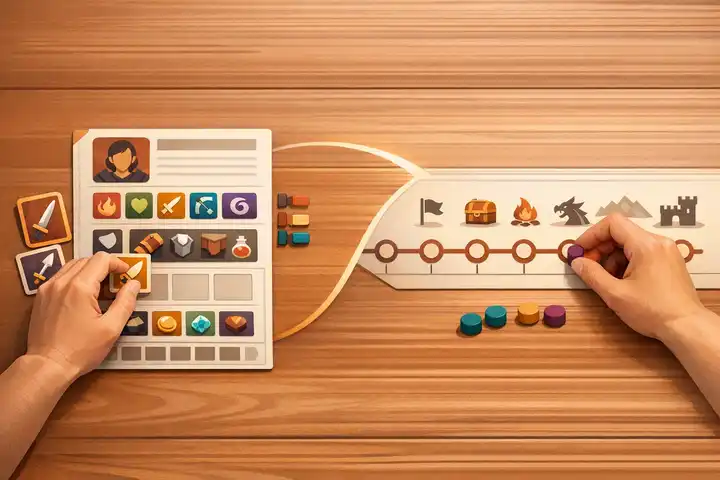
In RPGs, how characters grow impacts gameplay and storytelling. Two main approaches define progression: Player-Driven and Group Progression.
- Player-Driven Progression: You control how your character evolves, spending points to customize skills and abilities. This system offers freedom but requires planning and can lead to imbalanced parties if not managed well. Example: Savage Worlds.
- Group Progression: The entire party levels up together based on shared achievements. This ensures balance and simplifies management but limits individual customization. Example: Dungeons & Dragons.
Quick Comparison
| Feature | Player-Driven Progression | Group Progression |
|---|---|---|
| Control | High, individual decisions | Shared, collective growth |
| Balance | Harder to manage | Easier to maintain |
| Customization | High | Limited |
| Best For | Flexible builds, solo play | Team-focused campaigns |
Choosing the right system depends on your group’s preferences. Player-driven works for those who enjoy detailed character crafting, while group progression suits teams prioritizing collaboration and simplicity.

Player-Driven vs Group Progression Systems in RPGs Comparison
Vertical vs Horizontal Progression: Which is BETTER for RPGs
Player-Driven Progression Explained
Player-driven progression puts you in charge of how your character grows and evolves. Instead of following a rigid class template, you’re free to allocate experience points or advancements however you see fit. This means you’re not stuck being "just a fighter" or "just a wizard." Want to create a nimble thief dabbling in gadgetry or a swordmaster who also wields magic? You can make that happen.
The standout feature here is control. Instead of passively waiting for your class to dictate your next ability, you actively decide each upgrade based on your character's story and how you want to play. This approach leans heavily on what game developers call "horizontal progression." Rather than simply increasing stats, it broadens your choices and adaptability. As Game Developer Staff puts it, horizontal progression "gives the player tools to work with and then presents the question 'How can I use these options effectively?'".
Let’s take a closer look at the core elements of this system and see it in action with an example.
Core Elements of Player-Driven Progression
At its heart, this system thrives on customization, flexibility, and personalization. You get to decide which skills to enhance, which special abilities (often called "Edges" or "Feats") to unlock, and how to shape your character’s unique identity. This level of control helps you feel more connected to your character.
These systems often rely on a currency-based model. You earn points or advancements and spend them on options that align with your vision. There’s no set path, so you can pivot your character’s development mid-campaign without penalty. However, there’s a catch: planning ahead is crucial. Without careful thought, you might find yourself unable to meet the requirements for advanced abilities later on.
Example: Savage Worlds

A prime example of player-driven progression is found in Savage Worlds. Instead of traditional levels, this system uses "Advancements", grouped into Ranks like Novice, Seasoned, Veteran, Heroic, and Legendary. Every four advancements, your character moves up a Rank, but how you use each advancement is entirely up to you. As DM Freewolf, Lead Narrator of Savage Tales of Eberron, explains:
In Savage Worlds you don't level in the way that you might be used to in other d20 systems. You take Advancements... you as the player can do [what you want] with your character.
With each advancement, you can choose to increase an attribute, improve two skills, unlock a new Edge (a special ability), or remove a Hindrance (a character flaw). This system’s flexibility creates what DM Freewolf describes as a "sandbox" for character development:
You can truly create whatever you want for a character. Any path is truly available.
This example showcases how player-driven progression offers a continuous and tailored development experience, breaking away from the structured, one-size-fits-all approach of traditional leveling systems.
Group Progression Explained
Group progression flips the script on individual advancement. Instead of focusing on personal milestones and upgrades, everyone progresses as a team. The party shares resources, tackles challenges together, and grows as a single unit. Your character's development is directly tied to the group's overall success. This approach lays the groundwork for the detailed mechanics of group progression outlined below.
In this system, the adventuring party itself becomes the story's central "character." As Spencer, Co-Designer of Dungeon World 2, describes it:
The group as a whole is considered the 'main consistent character' of the game, with group playbooks defining the group's relationship with the world.
This method naturally balances gameplay - no one gets left behind, and no one races ahead. When the group defeats a major enemy or completes a key story arc, everyone levels up together. This keeps encounters manageable for the Game Master and ensures all players feel equally equipped for combat and exploration.
Core Elements of Group Progression
Group progression relies on a few key principles. At its heart are shared resources and collective goals. For example, Dungeon World 2 introduces mechanics like "Kinship" (a measure of how well the group works together) and "Wealth" (a shared pool of funds for gear and supplies). These resources are managed collectively by the party.
Advancement is tied to group-wide achievements rather than individual accomplishments. In Dungeon World 2, progress is tracked across three collective paths: Exploration, Heroism, and Teamwork. After each session, the group answers questions like "Did we stop a threat?" or "Did we uncover a secret?" Accumulating five progress points on any path earns everyone an upgrade simultaneously.
The system also includes mechanics that affect the entire party. For instance, "Burdens" such as being "Hunted" or "Bickering" impact everyone. A group burden like Bickering increases the cost of helping one another, pushing players to collaborate and resolve issues together rather than letting one person shoulder the consequences.
Teamwork is further encouraged through cooperative moves that offer mechanical advantages. Actions like "Assist" or "Comfort or Support" can grant allies better rolls or help remove negative conditions. These mechanics reward players for engaging with their teammates' struggles and backstories.
Many of these ideas are mirrored in popular systems like Dungeons & Dragons.
Example: Dungeons & Dragons
Dungeons & Dragons showcases group progression through its unified leveling system. The "Character Advancement" table ensures that experience point requirements for leveling up are the same for all classes. After a session, the Dungeon Master awards equal experience points to everyone.
This approach aligns with what Pathfinder 2nd Edition calls "Party Level", where all characters remain at the same power tier. The GM Core rulebook warns against uneven leveling:
Having characters at different levels can mean weaker characters die more easily and their players feel less effective, which in turn makes the game less fun for those players.
To address this, systems like double XP for lagging characters help maintain party cohesion, ensuring the group stays unified and capable of tackling challenges together.
Modern D&D groups often use milestone leveling, where the entire party advances after completing major story milestones instead of tracking individual experience points. This method simplifies bookkeeping and guarantees that everyone progresses together throughout the campaign.
Comparing Player-Driven and Group Progression
This section dives into the differences between player-driven progression and group progression systems. While one emphasizes individual control, the other focuses on shared advancement for the party as a whole.
In player-driven systems like Savage Worlds or GURPS, you can craft a character with almost no restrictions. This freedom allows for highly personalized builds but can feel overwhelming for newcomers. Additionally, experienced players might exploit the system to create overpowered characters, which can throw off the party's balance.
On the other hand, group progression systems, such as those in Dungeons & Dragons, lean towards predictability and balance. Each class follows a structured path, making it easier for the Game Master (GM) to design encounters that match the party's abilities. For example, a 5th-level wizard's capabilities are well-documented, which helps in planning. Interestingly, about 86% of surveyed D&D players prefer milestone leveling over traditional XP systems because it encourages teamwork and minimizes competitive XP farming.
The two systems also differ in how they engage players. Player-driven systems offer steady, incremental growth, allowing characters to evolve continuously. In contrast, group progression systems feature significant power boosts when the entire party levels up together. This highlights the balance between individual flexibility and collective harmony. Surveys indicate that most players identify as Socializers, prioritizing collaborative play over individual optimization.
Side-by-Side Comparison Table
Here’s a quick breakdown of the key distinctions between these progression styles:
| Category | Player-Driven Progression | Group Progression |
|---|---|---|
| Flexibility | High; spend points on any skill or edge (Savage Worlds) | Low to moderate; tied to class archetypes (D&D) |
| Customization | High; supports personalized character concepts | Moderate; limited by predefined class paths |
| Balance | Challenging; power levels vary greatly with player choices | Easier; power levels are predictable by level |
| Engagement | Focused on personal goals and gradual growth | Driven by narrative milestones and collective jumps |
| Role-Play Integration | Strong; character mechanics reflect individual choices | Can prioritize stats over role-play |
| Fairness for New Players | Variable; favors those familiar with optimization | High; ensures equal advancement for all players |
| Long-Term Viability | Offers replayability but risks "analysis paralysis" | Structured but susceptible to "power creep" |
| GM Workload | High; requires careful review of character builds | Low; system handles much of the balancing |
Choosing the Right Progression System
Picking the right progression system can make a big difference in how your campaign unfolds. It all comes down to what works best for your group’s preferences and goals.
When Player-Driven Progression Works Best
Player-driven systems shine in solo campaigns or when group attendance is inconsistent. They allow players to advance individually, which is a huge plus for games like Savage Worlds, where flexible scheduling is a key feature.
These systems are also perfect for players who want to create unique character concepts that don’t fit traditional molds. If your group includes experienced players who love diving into the nitty-gritty of tactical optimization and "build crafting", this model gives them the control they need to fine-tune their characters.
On top of that, player-driven progression adds depth to character-focused storytelling. It works especially well when personal backstories are woven into the main campaign, giving each player a chance to shine.
Of course, group progression has its own strengths, especially in campaigns that lean heavily on teamwork and collaboration.
When Group Progression Works Best
Group progression is ideal for campaigns where collective advancement is key. This system works particularly well for larger parties or cooperative campaigns, ensuring that everyone levels up together. By using milestones to advance the entire group, you avoid power imbalances that can happen when some players miss sessions or gain experience at different rates.
Interestingly, about 80% of tabletop RPG players identify as "Socializers", meaning they value teamwork over individual achievements. For campaigns with strong storytelling elements, group progression helps game masters maintain narrative flow and control the pacing. As Valerie from the D&D Community explains:
Milestone progression allows the DM to control the pacing of the game and ensures that all players are at the same level without having to worry about XP discrepancies.
This system also cuts down on the administrative workload, letting everyone focus more on role-playing and exploring the world.
For newer players, group progression provides a structured framework with clear roles, making it easier to learn the ropes. If you’re unsure which system is the best fit, try running a few one-shot sessions to test the waters and see how your group responds to the pacing and complexity.
Conclusion
Deciding between player-driven and group progression systems isn’t about finding the "right" answer - it’s about choosing what works best for your table. Player-driven progression shines when your group enjoys detailed customization and incremental growth, catering to those who love optimizing characters and crafting unique builds. On the other hand, group progression emphasizes shared narrative flow and simpler management, making it ideal for story-heavy campaigns where everyone advances together.
At its core, the choice boils down to structure versus flexibility. As gomad from Stack Exchange explains:
A class system... asks the player, 'Do you want to play this or do you want to play that?' A point-construction system asks, 'What do you want your character to be?'
This fundamental difference impacts everything - from the complexity of character creation to how the GM balances and paces the campaign.
When deciding, consider your group’s experience, campaign goals, and playstyle. Newer players often benefit from clear, predefined roles, while experienced players might prefer the creative freedom of point-based systems. What’s most important is ensuring players feel their progress - whether through sudden level-ups or steady skill gains. The specific method matters less than making sure the system rewards the actions and decisions your group finds enjoyable.
If you’re curious about exploring different progression styles, the TTRPG Games Directory is a great resource. It allows you to filter games by advancement models, from structured class paths to open-ended point-buy systems. You can even search for mechanics like "Advancement by Use" or compare vertical and horizontal progression options to find the perfect fit for your group’s preferences.
Ultimately, the best progression system is the one that keeps your players excited to return to the table. Experiment with different approaches in one-shots, listen to feedback, and adapt your campaign as needed to keep the adventure fresh and engaging.
FAQs
Can a campaign mix both progression styles?
Yes, campaigns can mix player-driven and group-based progression styles, and doing so often enhances the overall gameplay experience. These methods complement each other rather than clash. Systems such as experience points (XP), milestone leveling, or custom mechanics provide ways to balance individual growth with group advancement. Combining these approaches allows for more dynamic storytelling, giving players a sense of personal agency while maintaining the unity and cohesion of the group, creating a deeper and more engaging RPG experience.
How do you prevent balance issues in point-buy systems?
To keep point-buy systems fair and avoid balance problems, it's a good idea to set clear limits on ability scores. For example, you might establish a range like a minimum of 8 and a maximum of 15, with an overall cap of 20. This approach helps curb excessive min-maxing while ensuring characters remain balanced.
When designing these systems, consider key balance principles such as concept balance (ensuring character ideas are viable), naturalistic balance (making stats feel realistic), and spotlight balance (giving every character a chance to shine). Using predefined point costs with strict limits - like in Dungeons & Dragons 5th Edition - is another effective way to maintain fairness.
By combining these methods, you can create a system that feels fair and balanced while still allowing players plenty of creative freedom.
Which progression model works best with missed sessions?
The milestone leveling system is ideal for handling missed sessions. Rather than tracking experience points, this method progresses characters at significant story moments. It ensures steady advancement, even when players can't attend every session. This approach gives the Game Master (GM) the freedom to synchronize character growth with the storyline, keeping the game moving smoothly without penalizing absences.


