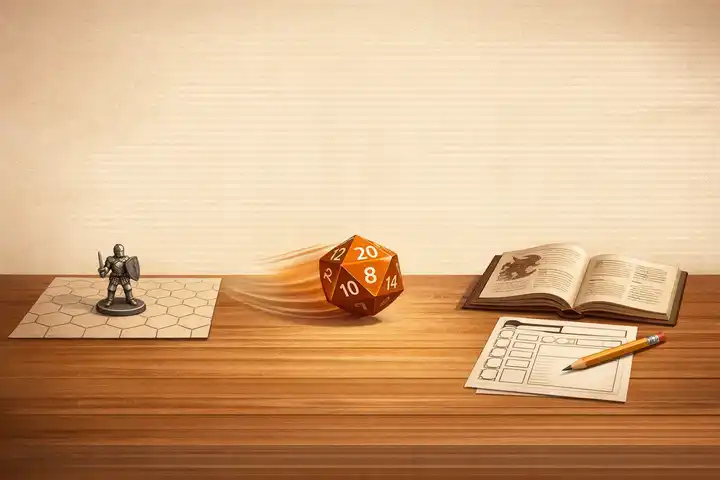
Dungeons & Dragons (D&D), first released in 1974, transformed gaming by introducing role-playing mechanics that focused on individual character growth and collaborative storytelling. Created by Gary Gygax and Dave Arneson, the game evolved from traditional wargames into a new genre, combining tactical gameplay with imaginative narratives. Key features like character classes, leveling up, and dice-based randomization set the standard for tabletop and video games alike.
Today, with over 54 million players worldwide, D&D continues to thrive, driven by its rich history, evolving editions, and widespread appeal in media and modern gaming culture. From its modest beginnings to its influence on both tabletop and digital gaming, D&D's legacy is undeniable.

Evolution of Dungeons & Dragons from 1974 to Present
D&D: Origins of the Game
The Creators: Gary Gygax and Dave Arneson
The origins of Dungeons & Dragons trace back to two passionate wargamers whose shared love for fantasy and strategy reshaped the world of gaming. Gary Gygax and Dave Arneson first crossed paths at the second Gen Con in August 1969, held in Lake Geneva, Wisconsin. Both discovered their passion for gaming through Avalon Hill's historical wargame Gettysburg during the late 1950s and early 1960s. Their early collaboration on a naval wargame, which led to the publication of Don't Give Up the Ship!, set the stage for their groundbreaking work.
In late 1972, Arneson traveled to Lake Geneva to showcase his Blackmoor campaign to Gygax. This campaign introduced a novel concept: instead of commanding armies, players controlled individual characters exploring underground dungeons. Gygax was captivated by the idea and asked for Arneson's notes, which were just 18 handwritten pages. Over the next few months, Gygax expanded these notes into a 50-page draft and tested the rules with his children in a campaign called Castle Greyhawk. This collaboration became the foundation of what would evolve into Dungeons & Dragons.
Gary Gygax: The Visionary
Gary Gygax, born in Chicago, was a driving force behind the structured mechanics that defined early tabletop role-playing games. Deeply involved in Lake Geneva's wargaming scene, he co-founded the International Federation of Wargamers and launched the first Gen Con convention in 1968, which initially attracted just 20 participants.
Gygax also created Chainmail, a set of miniature wargame rules. Its 14-page "Fantasy Supplement" introduced elements like wizards, monsters, and spells - concepts that became the core of D&D. By October 1973, Gygax had teamed up with his childhood friend Don Kaye to establish Tactical Studies Rules (TSR). Each invested $1,000 to fund the venture, with Kaye borrowing against his life insurance policy. Soon after, Brian Blume joined as a third partner, contributing an additional $2,000.
"Inspiration for all the fantasy work I have done stems directly from the love my father showed when I was a tad, for he spent many hours telling me stories he made up as he went along..."
– E. Gary Gygax, Co-Creator of D&D
While Gygax brought structure and tactical depth, Arneson introduced a new layer of storytelling to the game.
Dave Arneson: The Innovator
Dave Arneson, hailing from the Twin Cities in Minnesota, was a wargamer who brought a fresh perspective to tabletop gaming. As a member of Dave Wesely's gaming group, Arneson was inspired by Braunstein games, which emphasized individual roles and objectives.
Building on the Chainmail rules, Arneson developed his Blackmoor campaign, which introduced key role-playing elements like character progression, experience points, and dungeon exploration. His narrative-driven approach shifted the focus from large-scale battles to the personal stories of individual characters. This innovation transformed traditional wargaming into what we now recognize as role-playing games.
As James Haeck, Lead Writer at D&D Beyond, put it: "Dave Arneson was the man who introduced the idea of roleplaying to Gygax."
"From the CHAINMAIL® fantasy rules he drew ideas for a far more complex and exciting game, and thus began a campaign which still thrives as of this writing!"
– E. Gary Gygax, Co-Creator of D&D
The Development of Dungeons & Dragons
From Wargames to Role-Playing
Wargames of the past were all about large-scale tactics, focusing on commanding armies rather than individuals. But in 1967, Dave Wesely introduced something groundbreaking with his Braunstein scenario. Instead of overseeing massive forces, players now took on specific roles, each with unique goals. Wesely also brought in the idea of a neutral referee to handle unpredictable situations. This was a game-changer, creating the first true narrative-driven gameplay and paving the way for Dave Arneson's later innovations.
In 1971, Gary Gygax released Chainmail for $3.00. While it was mainly a medieval miniatures game, its 14-page fantasy supplement added rules for magic and mythical creatures, opening the door for fantasy elements in wargaming. Arneson took these ideas and applied them to his 1970 Blackmoor campaign, introducing a key feature: characters that could grow and evolve over time. Another major leap was the use of 20-sided polyhedral dice, which allowed for more varied and nuanced outcomes in combat and skills.
This shift - from managing armies to focusing on individual characters - set the stage for what would eventually become Dungeons & Dragons.
The Birth of the First Edition
The narrative-driven gameplay evolved quickly. After a successful demonstration of Arneson's Blackmoor campaign in late 1972, Gygax expanded Arneson's original 18 pages of notes into a 50-page draft. However, traditional wargame publishers were skeptical of this untested fantasy concept. Undeterred, Gygax partnered with Don Kaye, and together they founded Tactical Studies Rules (TSR) in 1973 in Lake Geneva, Wisconsin. Each contributed $1,000 to start the company - Kaye even borrowed against his life insurance policy to make it happen.
With a modest $2,000 budget, they produced the original Dungeons & Dragons boxed set. They allocated just $100 for artwork, paying local artists $2 for small illustrations and $3 for larger ones. Priced at $10, the set included three booklets: Men & Magic (36 pages), Monsters & Treasure (40 pages), and The Underworld & Wilderness Adventures (36 pages).
The game’s first print run of 1,000 copies saw a modest start, selling 150 units in the first month. But by the end of ten months, the entire run was sold out. A second print of 1,000 copies followed in the summer of 1974, and by 1975, sales had grown to 3,000 copies . The game’s success was recognized with awards like the Strategists' Club Award for Best New Game and the All-Time Best Role-Playing Rules award. Decades later, the legacy of this first edition remained strong - a first printing of the 1974 boxed set sold at auction in 2016 for over $20,000.
Core Mechanics and Concepts
Character Creation and Progression
In the original 1974 edition of Dungeons & Dragons, players took control of individual characters, each defined by six key attributes: Strength, Dexterity, Constitution, Intelligence, Wisdom, and Charisma. Players could choose from three core classes - Fighting-man, Magic-user, and Cleric - and select a race such as Human, Dwarf, Elf, or Halfling (originally referred to as "Hobbits").
Characters advanced by earning Experience Points (XP), which allowed them to level up. With each level, they gained more Hit Points (HP) and unlocked new abilities. This concept of character progression was first introduced by Dave Arneson during his Blackmoor campaign, where XP was awarded for defeating enemies and collecting treasure. The game also included a three-point alignment system - Law, Neutrality, and Chaos - and used mechanics like Armor Class (AC) for defense and Hit Points for measuring vitality.
These mechanics laid the groundwork for immersive storytelling, giving players a clear path for character development while empowering the Dungeon Master (DM) to weave engaging narratives.
Dungeon Master Role and Storytelling
The Dungeon Master quickly became the cornerstone of D&D's collaborative storytelling experience. Acting as the storyteller, referee, and game administrator, the DM controlled non-player characters (NPCs) and the game world itself. The 1974 edition emphasized the complexity of this role, noting that proper preparation required "hundreds of hours of work".
Gameplay followed a straightforward yet powerful loop: the DM described the environment, players declared their actions, and the DM narrated the outcomes. This structure offered players an incredible level of creative freedom, often described as "total freedom of action." RPG historian Stu Horvath famously remarked that the first Dungeon Master's Guide was "an accidental portrait of the man's [Gygax's] brain circa 1978". The DM also had the authority to adapt or invent rules on the fly, a flexibility that D&D Beyond highlights as a key feature: "The DM can improvise to react to anything the players attempt, D&D is infinitely flexible, and each adventure can be exciting and unexpected".
This adaptability allowed for persistent, multi-session campaigns, where stories could evolve organically over time, creating unforgettable experiences for players.
Dice Mechanics and Randomization
One of the game’s most groundbreaking innovations was its use of polyhedral dice, which brought an element of unpredictability to gameplay. Gary Gygax revolutionized tabletop gaming by moving beyond the traditional six-sided dice of earlier wargames, introducing dice like the d4, d8, d10, d12, and the now-iconic d20. These dice allowed for more nuanced probabilities, making actions like climbing, picking locks, or dodging traps far more dynamic.
In play, players rolled these dice and added their character's ability bonuses to meet or exceed specific Difficulty Classes (DC). While stronger characters had better odds, the randomness ensured that outcomes were never guaranteed. Tim Waddell of The Space Gamer captured this sentiment perfectly: "The most stimulating part of the game is the fact that anything can happen. Nothing is impossible".
The d20, in particular, became a symbol of the tabletop role-playing game (TTRPG) hobby. By 2024, Dungeons & Dragons had amassed a global player base of 50 million, with these dice mechanics forming the foundation for countless other TTRPG games in the genre. The unpredictability they introduced remains one of the defining features of D&D to this day.
Impact and Legacy
D&D's Role in Shaping the TTRPG Genre
When it comes to tabletop role-playing games (TTRPGs), Dungeons & Dragons (D&D) is the undeniable trailblazer. First published in 1974, D&D set the stage for the modern TTRPG industry. It introduced groundbreaking mechanics like character classes, experience points (XP), leveling up, and armor class - concepts that are now staples in the genre. Essentially, it created the blueprint that many games still follow today.
The release of the 3rd Edition under the Open Game License (OGL) and the d20 System was another game-changer. This move allowed third-party creators to develop compatible content, creating a thriving ecosystem of new games. Titles like Pathfinder, Call of Cthulhu, and Vampire: The Masquerade owe much of their success to this open framework. Rodney Thompson, one of the co-designers of D&D's 5th Edition, summed it up perfectly:
"There's a reason why nearly every big-name American game designer will cite D&D as a formative influence, because the principles of D&D help form the foundation upon which modern game design is built".
But D&D's influence didn’t stop at tabletops. Its mechanics helped shape the world of role-playing video games, inspiring classics like World of Warcraft and Final Fantasy. Even first-person shooters have roots in D&D - industry legends like John Carmack and John Romero, who were instrumental in creating the genre, were avid D&D players. Their early games borrowed dungeon-crawling elements directly from their tabletop adventures. The ripple effect is enormous: in 2014, the multiplayer shooter Destiny raked in over $325 million in sales within just five days, a testament to the enduring appeal of RPG-inspired design.
By setting these standards, D&D not only shaped an industry but also laid the groundwork for its cultural evolution.
From Niche Hobby to Mainstream Success
What started as a niche pastime in the 1970s has grown into a mainstream phenomenon. The groundwork laid by Gary Gygax and Dave Arneson has blossomed into explosive growth, especially in recent years. Sales of D&D's 5th Edition surged by 41% in 2017 and another 52% in 2018, making those years the most successful in the game's history. By 2019, the player base had shifted dramatically: 39% of players identified as female, and 40% came from Gen Z. This shift highlights how D&D has evolved from a basement hobby into a cultural juggernaut.
Pop culture has also embraced D&D in ways no one could have predicted. The game featured prominently in Netflix’s hit series Stranger Things, which even inspired a specialized D&D campaign released in May 2019. Celebrity players like Joe Manganiello, Deborah Ann Woll, and Stephen Colbert have brought the game further into the public eye through streamed sessions and web series. Beyond the gaming table, D&D’s concept of “leveling up” has infiltrated everyday life, influencing things like credit card rewards and hotel loyalty programs. Even conventions like Gen Con, which began in 1968 with just 20 attendees, now attract over 60,000 people annually.
Modern Resources for TTRPG Players
As D&D continues to grow, it’s also adapting to the digital age. Tools like D&D Beyond, Roll20, and other virtual tabletops have made it easier than ever to manage characters, build campaigns, and play remotely. Streaming platforms like YouTube and Twitch have also opened the door for new players, offering a way to learn by watching seasoned groups in action.
For those curious about what lies beyond D&D, there’s an entire world of TTRPGs to explore. The TTRPG Games Directory (https://ttrpg-games.com) is a fantastic resource, listing a wide variety of games, from classic titles to indie gems. Each entry includes detailed descriptions of mechanics, themes, and unique features, making it simple to find a game that matches your style - whether you’re into strategic combat, rich storytelling, or deep character development.
D&D's legacy is more than just its history; it’s a living, evolving force that continues to shape how we play, create, and connect.
Conclusion
Dungeons & Dragons didn’t just create a game - it sparked an entire genre. When Gary Gygax and Dave Arneson introduced the first edition back in 1974, they couldn’t have predicted the cultural wave it would set off. Fast forward to 2024, and the game boasts an astonishing 54 million fans worldwide. Their ideas, while simple, were revolutionary: experience points, character classes, and open-ended storytelling laid the groundwork for what we now recognize as modern tabletop role-playing games.
These early innovations didn’t just define D&D - they shaped gaming culture as a whole. Concepts like character progression, the Dungeon Master role, and the iconic d20 System became staples, influencing not only tabletop RPGs but also video game design. What started as a niche pastime turned into a blueprint for how games could tell stories and build immersive worlds.
What keeps D&D relevant decade after decade is its limitless adaptability. As reviewer Andy Pudewa aptly put it, "D&D is a fantastical outlet for the imagination. It has the quality of being infinitely flexible". Campaigns can stretch on for years, bound only by the creativity and commitment of the players. This boundless potential, paired with collaborative storytelling, turned what began as a hobby into a cultural cornerstone that continues to grow and inspire.
From its modest origins to its status as a global phenomenon, D&D’s story proves that groundbreaking ideas can redefine industries and resonate across generations. Its lasting impact highlights the power of imagination and storytelling, creating a legacy that continues to shape how we play and connect.
FAQs
How did Dungeons & Dragons develop from traditional wargames?
Dungeons & Dragons emerged from the world of traditional wargames, combining strategic gameplay with the creativity of storytelling. While early wargames primarily recreated historical battles, D&D shifted the focus to fantasy settings, introducing magic, mythical creatures, and character-driven plots. This new approach offered players a more engaging and collaborative way to play.
The game’s origins trace back to Gary Gygax and Dave Arneson, who modified the Chainmail ruleset, initially crafted for medieval combat scenarios. By incorporating role-playing elements and fantastical themes, they moved the spotlight from large-scale conflicts to individual adventures, laying the groundwork for the tabletop role-playing games we know and love today.
Who were Gary Gygax and Dave Arneson, and what were their contributions to Dungeons & Dragons?
Gary Gygax and Dave Arneson joined forces to create Dungeons & Dragons, the tabletop role-playing game that became a cornerstone of the RPG genre. Gygax played a key role in crafting the game’s structure and mechanics, as well as bringing it into the public eye. Meanwhile, Arneson introduced groundbreaking ideas like role-playing elements and story-driven campaigns.
By blending their unique contributions, they developed a game that has left a lasting mark on both tabletop and video games, shaping the role-playing landscape for generations.
How has Dungeons & Dragons shaped video games and pop culture?
Dungeons & Dragons (D&D) has left a lasting mark on modern video games and pop culture, shaping many of the elements we now take for granted. Features like character customization, immersive storytelling, and strategic combat - core mechanics originally designed for tabletop adventures - have become essential components of role-playing video games (RPGs) and even influenced other gaming genres.
But D&D's impact goes far beyond the gaming world. It has inspired movies, TV shows, and mainstream media with its themes of imagination, collaboration, and epic adventure. The game also pioneered the idea of storytelling as a shared, interactive experience, a concept that streaming platforms and online communities have embraced. Today, millions tune in to watch gameplay sessions, proving that D&D continues to be a cultural powerhouse. Its legacy fuels the creativity of fans and creators alike, encouraging them to push the boundaries of storytelling and explore new worlds.


