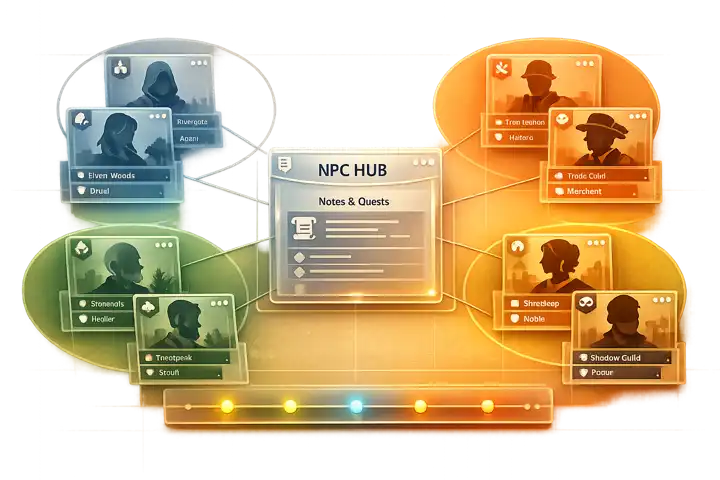
Managing NPCs in long RPG campaigns can feel overwhelming, but a solid system makes it easier. Here's how you can stay organized and keep NPCs engaging:
- Track Key Details: Focus on essentials like name, appearance, motivations, quirks, and an activity log for consistency. For minor NPCs, simple notes on appearance, behavior, and their role in the story work well.
- Group NPCs: Organize by location, faction, or role to quickly find relevant characters during gameplay. This saves time and ensures consistency in your world-building.
- Use Tools: Combine physical methods like index cards or journals with digital platforms like Roll20 or Campaign Logger for quick access and updates.
- Update Regularly: After each session, log changes to NPCs, summarize interactions, and refine your notes to avoid clutter.
- Reuse Characters: Instead of introducing new NPCs, revisit existing ones to strengthen continuity and deepen player connections.
Whether you prefer physical notes or digital tools, consistency is key. By staying organized and regularly updating your records, you’ll create a dynamic, immersive world for your players.
TOP 4 Ways to Track Your NPCs for D&D | DastardlyD&D
What Information to Track for NPCs
Memorable NPCs come to life through well-organized, concise notes. You don’t need to write a novel for every barkeep or guard, but capturing the right details ensures your characters feel consistent and believable. The trick is finding the balance - enough to roleplay effectively without drowning in notes.
Core Details to Record for Each NPC
For each NPC, focus on the essentials: name, physical description, values, mannerisms, speech patterns, motivations, secrets, an activity log, and practical details like clues or resources . This streamlined "universal roleplaying template" equips you with everything needed to portray the character convincingly. For example, a guard captain who values duty, nervously taps his sword hilt, and speaks in short, clipped phrases immediately feels authentic and fits seamlessly into the campaign’s dynamics.
For recurring NPCs, keep an activity log to track their interactions with the players. Justin Alexander, a respected RPG producer, puts it simply:
"An activity log simply records the NPC's interactions with the PCs for easy reference and consistent continuity".
Practical details are just as important. Note any clues the NPC holds, resources they can provide, or specific actions they’re meant to take during a scene. To stay organized, limit your notes to one page per NPC and highlight key names, locations, or events for quick reference during gameplay. For minor NPCs, a simpler approach works: jot down their appearance (key physical traits), portrayal (how they speak and act), and hook (their connection to the plot).
Once you’ve recorded these details, grouping NPCs by location, faction, or role makes managing your campaign even easier.
Categorizing NPCs by Location, Faction, or Role
Organizing NPCs by location, faction, or story role turns a messy collection of notes into a practical reference system. For example, grouping characters by districts - like the merchant quarter - lets you quickly find relevant NPCs without flipping through endless pages. Separating them by themes, such as noble houses versus criminal guilds, can also help maintain consistency and make each area feel distinct.
Faction-based organization is especially useful in campaigns involving political intrigue or shifting alliances. Use tags like "Greedy" or "Ally" to track an organization’s overall stance toward the party, and include scales to measure positive or negative sentiment over time. This method ensures you don’t overdevelop minor characters. For instance, a one-off NPC delivering a single clue requires far less detail than a faction leader with intricate goals and relationships.
Plus, categorized lists make it easy to reuse characters. That merchant the party helped three sessions ago? They could reappear with a new quest hook, deepening the players’ connection to your world. By keeping your NPCs organized, you’ll always have the right character ready to enrich your story.
Physical Methods for Tracking NPCs
Index Cards and Printable NPC Sheets
Index cards are a handy, portable way to keep track of essential NPC details. A simple 3-line method works great for minor NPCs: jot down their appearance (like "crooked nose"), their manner of speaking (e.g., "speaks slowly"), and a key hook (such as "knows bandit hideouts"). This quick-reference system ensures you can bring these characters to life instantly during gameplay.
For more prominent NPCs, consider using a one-page briefing sheet. This sheet can include their motivations, secrets, and relationships. Justin Alexander, an RPG producer at Atlas Games, shares his method:
"I try to have one NPC per page. And will try very hard to keep them on just one page... the benefits in being able to quickly access information during play are usually worth tightening the NPC up".
To keep these sheets organized, store them in a three-ring binder for easy access. Highlight key details like became a diplomat or lost himself in drink to make scanning faster during play. Add a picture at the top for a quick visual reference, and use the back of the sheet for handwritten updates to keep the information current.
While index cards and briefing sheets are great for individual NPCs, a campaign journal can help you track interactions and developments on a larger scale.
Campaign Journals for Recording NPC Information
A campaign journal serves as a chronological log of every NPC encounter. After each session, update the journal with memorable details about the NPCs you’ve met. To make things easier to navigate, organize entries by location or faction, reflecting the structure of your game world. For recurring NPCs who haven’t appeared in a while, include a "Since Last We Met" note - mentioning things like new scars, recent travels, or changes in social standing - to keep them feeling dynamic and connected to the story.
These physical methods pair well with digital tools, ensuring that every NPC remains a meaningful part of your evolving campaign.
Digital Tools for NPC Organization

Physical vs Digital NPC Tracking Tools Comparison for RPG Campaigns
Organizing NPCs on Roll20 and Similar Platforms

Roll20 offers a Page Folders system that makes organizing NPC portraits and maps straightforward. You can create nested folders based on region, faction, or story arc. Plus, its built-in search field supports partial-match queries, so finding an NPC like "Merchant Guildmaster Theron" is quick and easy.
For a more interactive approach, you can build a macro directory using a spreadsheet system, as suggested by Keith Curtis. This setup allows you to create a clickable chat menu. Clicking an NPC's name displays their portrait and public description for players while privately sending you GM notes. To save on Roll20 storage, you can host images externally on platforms like Imgur.
Campaign Logger takes things further with its @mention tagging system. For example, typing @Baroness Elara links all related details across session entries, complete with autocomplete and custom labels. This tool, priced at $5 per month, also tracks changes to NPC statuses (e.g., "Ally", "Enemy", or "Dead") and ensures consistent spelling throughout your campaign.
Physical vs. Digital Tools: A Comparison
| Factor | Physical (Index Cards/Journals) | Digital (Roll20/Campaign Logger) |
|---|---|---|
| Searchability | Manual flipping through pages/cards | Instant search with partial-match and tag filtering |
| Organization | Fixed; requires rewriting | Drag-and-drop folders, dynamic tagging |
| Accessibility | Limited to physical presence | Syncs across devices (phone, tablet, PC) |
| Cost | Low (paper and ink) | Free (Roll20 basics) to $5/month (Campaign Logger) |
| Automation | None; manual entries only | Autocomplete, generators, cross-linking |
| Visual Clutter | Needs physical desk space | Can get cluttered without folder management |
Roll20's basic organizational features are free, making it an accessible option for most groups. One of the key advantages of digital tools is their flexibility. For instance, moving an NPC from "Town Guard" to "Rebel Faction" is as simple as dragging and dropping. By contrast, physical cards require rewriting or reshuffling. Still, physical methods remain a reliable backup when digital options aren't available.
These digital tools work well alongside traditional approaches, providing dynamic reorganization and fast search capabilities that streamline campaign management.
Keeping Your NPC Records Up to Date
Creating a Post-Session Update Routine
Keeping your NPC records up to date starts with a solid post-session routine. After each session, take time to update your logs. If you use physical sheets, jot down quick notes during play, then transfer those details into a more permanent record afterward. This method ensures you stay organized without disrupting the flow of gameplay.
Focus on three key updates during your post-session review. First, write a 2-3 sentence summary of the session, noting which NPCs appeared and what they accomplished. Second, update any changes to an NPC's status - this could include adjustments to their health, items they acquired, or evolving relationships with the player characters. Lastly, document any improvised details, like new names, locations, or bits of lore, in a "Known Facts" list.
"Your goal is not to write a short story describing these events to some third party audience: You're creating a quick reference for jogging your memory, making sure you don't forget anything, and keeping the continuity straight." - Justin Alexander, Author and RPG Producer
For NPCs that appear regularly, use an activity log to track their interactions and major developments over time. If these logs start to feel bloated after several sessions, take the time to condense older entries. Details from a dozen sessions ago can often be summarized in a single sentence, keeping your records streamlined and easy to reference during play.
By maintaining detailed notes and periodically trimming them down, you ensure your campaign stays organized and engaging.
Reviewing NPC Records for Long-Term Campaigns
As your campaign progresses, regular updates alone might not be enough. Long-term campaigns benefit from periodic reviews of your NPC roster to keep things manageable. Before introducing new characters, consider the Law of Conservation of NPCs. Does your story need a merchant or informant? Instead of creating someone new, see if an existing NPC can fill the role. Reusing familiar faces strengthens player connections and reinforces the continuity of your world.
After completing a few story arcs, review your roster of supporting characters. Move NPCs who haven’t appeared in 3-5 sessions to a "Probationary" section. If they continue to remain unused, remove them from your active list to reduce clutter. On the flip side, if an NPC struck a chord with your players, add them to your master "Cast of Characters" list immediately. This gives you a dependable pool of characters to draw from whenever the story calls for it.
When reintroducing NPCs after a long absence, include a "Background – Since Last We Met" section in your notes. Jot down one or two things they’ve been doing off-screen - whether it’s running their business, advancing their faction’s goals, or handling personal challenges. This small addition makes your world feel more alive and provides instant conversation hooks when players reconnect with these characters.
Conclusion
A good NPC tracking system can turn a series of random encounters into a cohesive and dynamic campaign. Whether you prefer the tactile charm of index cards or the convenience of digital tools, the key lies in consistency, not the method itself.
To keep things organized, choose a single place to store all your NPC details. This could be a notebook, a spreadsheet, or a dedicated app - whatever works best for you. Once that's set, build habits around it: update your records after every session, note how NPCs change based on player actions, and occasionally review your list to keep it manageable. These small, regular actions can make your game world feel alive and responsive.
"Knowing that NPCs are 'doing stuff' even when they're not in [the players'] direct line of sight will make the game world truly feel alive." - Justin Alexander, Author and RPG Producer
As your campaign evolves, your system should adapt too. Test its effectiveness by how easily you can recall an NPC’s voice, goals, or quirks when needed. If you find yourself drowning in notes, simplify and streamline your records.
The benefits of keeping your NPCs well-organized are undeniable. Players will see their choices ripple through the world, relationships with NPCs will grow richer, and your campaign will develop the depth and connection that make stories unforgettable. Stick to consistent habits, centralize your notes, and refine your process - these are the building blocks for turning fleeting moments into memorable tales.
FAQs
What’s the minimum I should note for a one-off NPC?
At the very least, jot down the NPC's name and a few essential details, like their role or purpose in the session. This approach keeps your notes brief while making it easy to reference and incorporate the NPC during gameplay. By keeping things straightforward, you ensure your campaign stays organized and free from unnecessary clutter.
How do I keep NPC notes from getting too long?
Streamline your NPC notes by summarizing the most important details on a single page. Using tools like worksheets or briefing sheets can help you focus on critical traits and relationships without overloading your notes. For NPCs that appear frequently, maintain a brief list of key characters and log interactions in an activity log. This way, you can track developments without creating unnecessary clutter, ensuring your notes stay organized and easy to reference during gameplay.
How can I reintroduce an NPC after many sessions?
To bring an NPC back into the story after a long absence, it helps to keep an activity log that records their previous interactions and key details. This allows you to reference their past relationships or any unresolved storylines, which can spark renewed interest from the players. Another approach is to reintroduce the NPC in a fresh role or context that still ties into their established history, creating continuity while offering something new. Using tools like a "Who’s Who" list can also make it easier to manage recurring characters, ensuring their reappearance feels seamless and purposeful.


