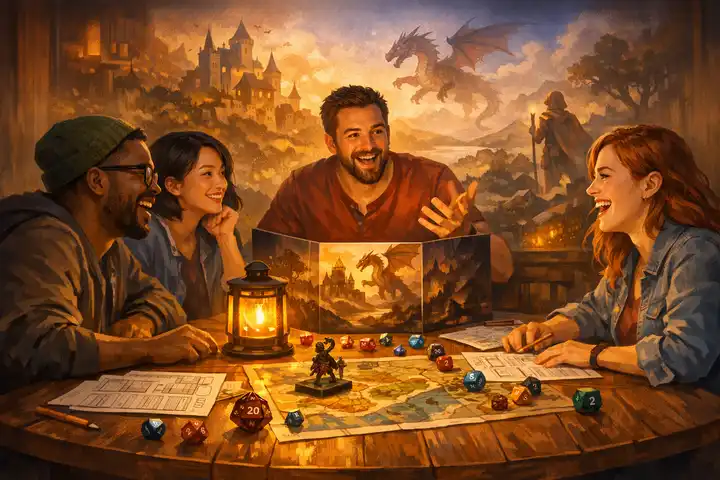
Dungeons & Dragons (D&D) revolutionized gaming by introducing collaborative storytelling, character-driven gameplay, and a focus on teamwork over competition. Since its launch in 1974, it has shifted gaming from rigid, rule-based systems to open-ended, narrative-driven experiences. Players create unique characters, interact with a Dungeon Master (DM), and co-create stories, emphasizing creativity and social interaction.
Key takeaways:
- Role-Playing Focus: Players embody characters, shaping stories together.
- Collaboration: Success depends on teamwork, with each character contributing distinct skills.
- Social Benefits: Improves communication, empathy, and problem-solving.
- Cultural Shift: Once controversial, D&D is now mainstream, inspiring modern games and media.
- Broader Impact: Used in education, therapy, and corporate training for skill-building.
D&D's legacy extends beyond the table, influencing cooperative video games, educational tools, and even fostering inclusive communities. Its emphasis on shared storytelling has forever changed how we connect and play.
Why D&D helps you make friends // Theory Application
How D&D Shifted from Strategy Games to Collaborative Storytelling

Evolution of D&D from Wargames to Collaborative Storytelling 1969-1974
Dungeons & Dragons (D&D) has come a long way from its roots in traditional wargames, where players commanded armies across battlefields. It transformed into a system that focuses on individual role-playing and immersive storytelling. Early innovations, like Wesely's role-assumed wargames in 1969, Gygax's "Chainmail" fantasy supplement in 1971, and Arneson's cooperative "Barony of Blackmoor", laid the groundwork for this shift. By the time the first edition of D&D launched in January 1974, it introduced groundbreaking elements: individual character stats, distinct species like humans, dwarves, elves, and hobbits, and specialized classes such as fighters, magic-users, and clerics. This marked a clear departure from the unit-based gameplay of its predecessors.
As Louis Fiori aptly put it:
"Gary Gygax and Dave Arneson didn't technically invent tabletop role-playing games, but they formalized the foundations: character sheets, dice as central mechanics, numerical attributes to define heroes, and above all, a deeply cooperative approach".
This evolution also introduced a pivotal role that would become the heart of the game: the Dungeon Master.
The Dungeon Master and Player Dynamic
The Dungeon Master (DM) emerged as the driving force behind D&D's storytelling experience. Unlike traditional games with predetermined outcomes, the DM acts as a referee, storyteller, and world-builder, crafting the setting and challenges for the players to navigate. Max Hemingway explains:
"A player designated as the Dungeon Master (DM) serves as the game's referee and storyteller, while also maintaining the setting in which the adventures occur, and playing the role of the inhabitants".
This dynamic creates an ongoing conversation between the DM and the players. The DM sets the scene, presents challenges, and populates the world, while players respond through their characters' actions and decisions. Simon K Jones captured this collaborative essence:
"At its best, when you have a master DM running the game, Dungeons & Dragons is oral storytelling at its most sophisticated. It's telling tales around a fire, developed to its ultimate form. It's improv theatre. It's pure creative discovery, with the DM and players combining their imaginations in unpredictable and thrilling ways".
Open-Ended Gameplay and Player Freedom
One of D&D's defining features is its emphasis on narrative freedom. Unlike games with rigid win-or-lose conditions, D&D prioritizes the story over competition. Players create characters, make decisions, and improvise actions within a loose framework, allowing the story to unfold in unexpected and exciting ways. This open-ended approach encourages creativity, problem-solving, and collaboration, making every session unique.
Party-Based Play and Group Interaction
D&D also revolutionized gaming by shifting the focus from commanding armies to embodying individual characters within a cooperative group. In traditional wargames, players controlled large units; in D&D, the spotlight is on personal roles and teamwork. Each character brings unique skills to the table - fighters protect spellcasters, clerics heal the group, and rogues handle stealthy tasks - creating a system where collaboration is key, and success depends on the group working together.
This structure fosters a deeply social experience. Michael Witwer, author of Empire of Imagination, highlights the irreplaceable value of in-person gaming:
"sitting around with your friends and participating in this kind of group storytelling exercise: actually being in a room physically sitting at a table with nothing but pencils and paper and dice. There's something very special about that, and it's kind of a social experience that's pretty hard to frankly re-create over any type of electronic media".
Events like the gaming meetups hosted by Dragons, Dungeons, & Drinks in the Twin Cities in July 2025 - centered on the motto "We are built on play, storytelling, and making friends" - show how D&D continues to bring people together, building communities and forming lasting connections.
The Social Skills D&D Helps Players Develop
Dungeons & Dragons (D&D) is more than just a game; it's a dynamic way to build essential social skills. Each session demands players to communicate clearly, listen actively, and collaborate effectively. Whether it's describing their characters' actions, engaging in improvised dialogue, or deciding the best course of action in tricky situations, players are constantly honing these abilities. These overarching skills lay the groundwork for the more specific benefits outlined below.
Building Communication and Decision-Making Skills
D&D thrives on constant, open communication. Players must clearly explain their intentions, discuss strategies, and collectively decide on solutions to puzzles or combat scenarios. This group problem-solving mirrors everyday situations, whether it's brainstorming for a work project or coordinating plans with friends. The collaborative nature of the game makes communication and decision-making second nature to its players.
Learning Empathy Through Character Role-Play
Role-playing in D&D goes beyond fun - it’s a way to step into someone else’s shoes. By embodying characters with unique backgrounds, motivations, and values, players explore perspectives they might never encounter otherwise. For instance, during virtual D&D sessions hosted by Game to Grow in 2020–2021, participants grew attached to an NPC named Seamus, a soup tavern owner. When skeletons attacked his tavern, one player shouted, "You're not killing my soup man!" as others worked to protect the patrons.
Devyn Rorem, a master's student in educational psychology at the University of Alberta, highlighted how D&D lets players safely experiment with identities:
"try on different identities - to play with gender and different personality traits - testing identities safely before applying them in real life".
Research backs this up. A 2016 study revealed that 127 role players demonstrated above-average empathy levels. Additionally, therapists have used D&D to help children with autism develop perspective-taking skills, showing its value in fostering understanding.
Practicing Conflict Resolution and Teamwork
Teamwork is at the heart of D&D. The game’s cooperative nature encourages players to resolve conflicts and work toward shared goals. Disagreements - whether over rules or clashing character motivations - are settled through communication that ensures everyone enjoys the experience. The emphasis on collaboration extends to overcoming in-game challenges, where negotiation and diplomacy often take precedence over combat. This approach not only strengthens group dynamics but also helps players recognize and value the unique contributions of their teammates.
How D&D Creates Spaces for Community and Acceptance
How Public Perception of D&D Has Changed
Dungeons & Dragons has come a long way from its controversial beginnings to becoming a beloved mainstream pastime. Back in the 1980s, the game was at the heart of a moral panic, with fundamentalist religious groups accusing it of being dangerous and corrupting. Fast forward to today, and shows like Critical Role and Dimension 20 have helped transform its image. These programs have drawn in a broader, more diverse audience, showcasing the creativity and camaraderie at the heart of the game.
This shift in public perception has not only boosted D&D's popularity but also encouraged meaningful changes in its content and the values of its community.
Representation and Diversity in D&D Materials
In its earlier days, D&D often leaned on problematic portrayals of fantasy races, depicting orcs and drow as inherently evil or monstrous. In June 2020, the D&D development team openly addressed these issues, recognizing that such depictions were "painfully reminiscent of how real-world ethnic groups have been and continue to be denigrated." To correct this, they committed to revising descriptions, updating rules, and moving away from harmful stereotypes.
Over the years, the game has shifted from being a predominantly white, male-dominated hobby to a more inclusive space. This transformation has been driven by both the creators and the players, with Game Masters and players alike crafting game worlds that welcome everyone. These changes have allowed people from a variety of backgrounds to feel seen and represented, both in the game's materials and at the table.
D&D Communities Online and In Person
D&D's commitment to inclusivity isn't limited to the pages of its rulebooks - it extends into the vibrant communities that play the game. Whether through local game stores, clubs, or online platforms, D&D has become a way for people to connect and build meaningful relationships.
Shows like Dimension 20 and Critical Role have played a huge role in expanding D&D's reach, showing that the game truly is for everyone. These programs not only entertain but also serve as examples of inclusive play, inspiring countless viewers to start their own campaigns. For many, these shows provide the confidence to join or create their own groups, knowing they'll find a welcoming and accepting space at the table.
D&D's Impact on Modern Social Gaming
Dungeons & Dragons (D&D) has left an undeniable mark on modern gaming, weaving its collaborative and imaginative legacy into the fabric of today’s social and narrative-driven games.
How D&D Shaped Cooperative Game Design
D&D laid the groundwork for what we now recognize as cooperative gaming. It was one of the first games to show that open-ended, collaborative play could create richer, more engaging experiences. Unlike games that follow strict, linear rules, D&D thrived on player creativity and interaction. This approach inspired modern RPGs like Card Hunter and Detroit: Become Human, which echo D&D’s emphasis on player-driven narratives and branching storylines. These games capture the essence of a D&D session, where player choices shape the outcome rather than being confined to a predetermined path.
By prioritizing player agency and non-linear gameplay, D&D redefined what games could be, turning storytelling into a central pillar of game design.
Making Narrative Play a Standard Part of Gaming
D&D didn’t just introduce cooperative play - it made storytelling a key element of gaming. The Dungeon Master’s (DM) role as a storyteller became a model for game designers, inspiring features like dialogue trees, branching narratives, and environmental storytelling. These tools guide players through immersive worlds while still allowing them the freedom to shape their own stories.
"D&D is about the narrative and how you create it, emphasizing the importance of pacing and tension in storytelling."
– Matt Mercer, Critical Role
Today, whether you’re playing a tabletop RPG or a digital adventure, narrative depth and player choice are expected features. This shift has extended far beyond entertainment, influencing fields like education, therapy, and even corporate training.
Using D&D Methods Beyond Gaming
The creativity and collaboration that define D&D have found applications in unexpected places. For over a decade, teachers have used D&D to enhance classroom learning. One English teacher, for example, has students create characters, research detailed backstories, and design adventures for their peers. This method has been shown to improve reading skills across diverse groups of students.
In the medical field, a 2013 study in Brazil highlighted the effectiveness of role-playing in teaching cellular biology. Among 127 participants, researchers noted higher levels of empathy and improved understanding of complex concepts. Similarly, an Australian study found that playing D&D for eight weeks led to reduced depression, stress, and anxiety, while boosting self-esteem.
Even corporate environments have embraced D&D-inspired strategies. Businesses use role-playing techniques to strengthen team dynamics and develop leadership skills. Therapists, too, have adopted these methods, helping clients build social confidence, process difficult emotions, and practice problem-solving in a safe, imaginative space.
It’s clear that D&D’s influence reaches far beyond the gaming table, proving that its principles of creativity, collaboration, and storytelling have the power to transform lives in countless ways.
Exploring More Tabletop RPGs with TTRPG Games Directory

While Dungeons & Dragons (D&D) set the stage for collaborative storytelling, the tabletop RPG (TTRPG) universe is much more expansive. Beyond D&D's fantasy roots, countless systems offer fresh mechanics and unique social dynamics. The TTRPG Games Directory acts as a guide, helping players discover games that match their play style. Let’s dive into how this directory highlights indie gems and classic systems, making it easier to find the perfect game for your group.
Finding Indie and Alternative TTRPGs
The directory organizes games into categories like Traditional, OSR (Old School Revival), Action/Adventure, Solo, and Dungeon Crawl systems. Indie titles such as Mausritter and DC20 showcase inventive mechanics, like physical inventory slots or a simplified Four Action Points combat system.
"Those entering the hobby for the first time can find hundreds of games within each of these genres. Think about what each genre offers, and start looking for some core rule systems."
– Wizard's Respite
For fans of licensed settings, options abound. Fallout: The Roleplaying Game immerses players in post-apocalyptic survival, while Star Trek Adventures opens up interstellar exploration. Games like Mutants In the Night by Orion Black focus on culturally rich narratives, centering on Black gamers’ experiences and empowering mutants battling systemic injustice. These examples highlight the incredible diversity available, ensuring there’s something for every group’s interests and dynamics.
Matching Games to Your Group's Play Style
The directory’s filtering options make it easy to find games tailored to your group’s preferences - whether that’s exploration, social interaction, or combat. Traditional systems lean heavily on dungeon crawling and tactical battles, while OSR games emphasize improvisation and creative storytelling. Action/Adventure TTRPGs deliver fast-paced, cinematic thrills, and Solo TTRPGs offer deeply personal storytelling experiences.
Games can also be sorted by character roles and activities. For instance, spellcasters might enjoy wizard-focused systems, stealth enthusiasts may prefer rogue-centric games, and combat lovers can dive into barbarian-heavy mechanics. By narrowing down choices, the directory ensures that the game aligns with your group’s preferred style of play.
Trying New Systems for Different Social Experiences
Exploring a variety of TTRPG systems can lead to new social dynamics and skill-building opportunities. While D&D excels at fostering teamwork and decision-making, other systems shine in areas like conflict resolution and creative problem-solving. Many games are designed with inclusivity in mind, creating safe spaces for identity exploration and meaningful dialogue.
"I think that play and storytelling is a fantastic way for you to try on identities in a safe environment with friends."
– Erika Ishii, Actor, Host, and Performer on Critical Role and Dimension 20
Some systems also incorporate cultural elements, challenging traditional fantasy tropes and offering players a chance to experience narratives from diverse perspectives. By experimenting with new games, players expand their horizons, develop empathy, and gain a deeper appreciation for the creative and social potential of TTRPGs.
Conclusion: D&D's Lasting Impact on Social Gaming
Dungeons & Dragons has revolutionized the way people engage with games, transforming them from competitive endeavors into opportunities for shared storytelling and collaboration. By introducing elements like character creation, party-based gameplay, leveling systems, and hit points, D&D laid the groundwork for modern game design. These features have become staples in popular MMORPGs and countless other video games, leaving a lasting mark on the gaming industry.
Beyond mechanics, D&D has had a meaningful impact on players' lives. Research shows that playing D&D can help foster empathy and alleviate depression, stress, and anxiety - insights that have influenced both educational and therapeutic practices.
The game's resurgence in popularity has been nothing short of remarkable. The release of its fifth edition in 2014, combined with celebrity endorsements from figures like Vin Diesel and Stephen Colbert, and its prominent role in shows like Stranger Things and Critical Role, has brought collaborative gaming into the mainstream. D&D has become a unifying force, creating inclusive communities and offering a shared language for connection.
D&D's legacy continues to inspire the tabletop role-playing game (TTRPG) world. The TTRPG Games Directory is a valuable resource for players looking to explore new systems beyond D&D. Whether your group enjoys tactical combat, improvisational storytelling, or character-driven adventures, the directory makes it easy to discover games that suit your style. Exploring these options opens doors to fresh social experiences and creative opportunities, all built on the foundation that D&D established.
Through its innovative approach to gaming, Dungeons & Dragons has sparked a movement that redefines how we play, connect, and grow. Its influence remains a guiding light in the ever-evolving world of social gaming.
FAQs
How has Dungeons & Dragons shaped modern video games?
Dungeons & Dragons (D&D) has left an undeniable mark on modern video games, introducing core ideas like character classes, stat-based systems, and collaborative storytelling. These mechanics became the backbone of early computer RPGs in the 1980s, with games like Ultima and Wizardry setting the stage. Even now, D&D's influence is clear in features like loot systems, quest designs, and turn-based combat found in many popular titles.
Beyond RPGs, D&D's focus on player choice and tactical gameplay has shaped entire genres, including first-person shooters, strategy games, and MMOs. Developers like Warren Spector have credited D&D for inspiring open-world storytelling and player-driven problem-solving, key elements in narrative-heavy games like Deus Ex. Japanese RPGs, such as Final Fantasy and Dragon Quest, have also drawn heavily from D&D’s class and magic systems, while MMOs continue to embrace its dungeon-based, cooperative gameplay model.
For those curious about the tabletop roots of these mechanics, the TTRPG Games Directory provides a curated selection of role-playing games, showcasing how D&D's legacy has evolved into today’s rich mix of tabletop and digital RPG experiences.
What is the role of the Dungeon Master in Dungeons & Dragons?
The Dungeon Master (DM) plays a central role in Dungeons & Dragons, acting as both the storyteller and the referee. They're the ones who craft the adventure, describe the world in vivid detail, and bring non-player characters (NPCs) to life. On top of that, they manage events and keep the game running smoothly by ensuring the rules are followed and resolving any disputes that arise during play.
In short, the DM creates the framework for players to dive into, encouraging them to collaborate, explore, and shape the unfolding story. This makes every session a one-of-a-kind, immersive experience.
How does Dungeons & Dragons help develop social skills?
Dungeons & Dragons (D&D) stands out as a game that blends entertainment with personal growth, particularly in social skills. By diving into role-playing and cooperative storytelling, players naturally enhance their communication, active listening, and problem-solving abilities. Whether it’s resolving in-game conflicts or collaborating on creative solutions, the experience encourages empathy, sparks imagination, and teaches the art of giving and receiving constructive feedback.
What makes D&D especially rewarding is its emphasis on teamwork. The shared adventures often create strong bonds among players, providing a safe and supportive space to build confidence and meaningful social connections. If you're curious about trying D&D or other tabletop role-playing games, the TTRPG Games Directory is a handy resource. It offers a curated selection of games tailored to various styles and preferences, making it easier to find one that suits your group and goals.


