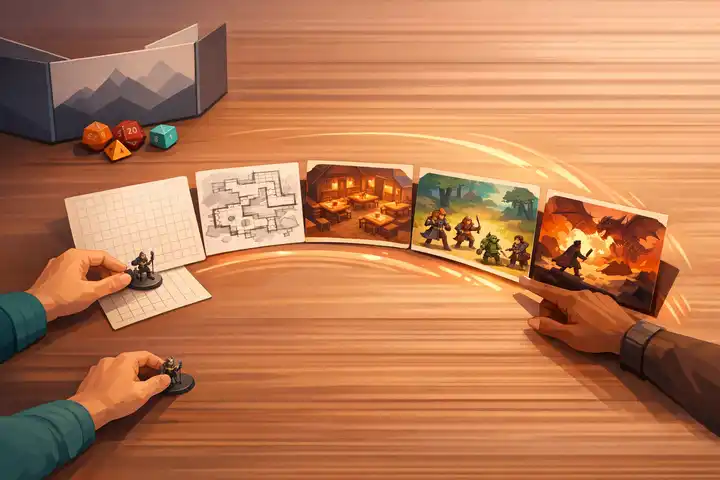
Crowdsourced modules are reshaping tabletop role-playing games (TTRPGs) by introducing flexible, community-driven stories and tools that empower both players and Game Masters (GMs). These modules allow creators to expand existing adventures, offering new props, quests, and narrative structures. Platforms like Kickstarter's Zine Quest have funded thousands of projects, raising over $6.25 million since 2019. Tools like Foundry VTT make integrating these modules seamless, while the Open Game License (OGL) has enabled creators to share and build on existing content.
Crowdsourced modules simplify GM prep, reduce costs, and bring fresh perspectives to gameplay. In contrast, GM-led storytelling thrives on improvisation and player interaction, allowing for more personalized experiences but requiring more effort. Both approaches enrich TTRPG storytelling, with many creators blending the two for maximum impact. The choice depends on your priorities: pre-made convenience or handcrafted narratives.
1. Crowdsourced Narrative Modules
Community Involvement
Crowdsourced modules have turned tabletop RPGs into a form of modern folk art, where stories are co-created by the community rather than simply consumed. The introduction of the Open Game License (OGL) in 2000 played a crucial role in this shift. By allowing creators to freely share and build upon existing content, the OGL opened the door for thousands of contributors, removing the burden from a single publisher. A great example of this is Paizo Publishing's Pathfinder Roleplaying Game, which became the best-selling RPG between 2011 and 2013. By using the OGL to maintain compatibility with D&D 3.5 rules, it directly addressed what the community wanted.
The scale of this collaborative effort is evident in projects like Justin Alexander’s "Alexandrian Remix" of the Eternal Lies campaign. In July 2021, Alexander shared his enhancements to the campaign, which included new props and adventures. These remixes often fix rigid storylines by using node-based designs, giving players more freedom and control. This kind of community-driven storytelling continues to reshape how narratives evolve in tabletop RPGs.
Narrative Flexibility
Traditional GM-led storytelling often limits the narrative to a few predefined paths. Crowdsourcing breaks these boundaries by incorporating what G.F. Pace calls the "collision of ideas", where fresh perspectives introduce unexpected twists and creative solutions. As Pace puts it:
The Folk sometimes can reach deeper into a problem than an Expert, because their fresh perspective cuts through bias.
This process leads to what Pace refers to as the "snowflake effect", where a single idea can grow into countless unique and diverse outcomes, thanks to the varied input of the community.
Accessibility for Players and GMs
Crowdsourced modules also make life easier for GMs by reducing the amount of prep work needed. Pre-made assets like characters, locations, and objects help lighten the creative and administrative load. For instance, in March 2023, researchers demonstrated how the text-based RPG LIGHT utilized 7,500 crowdsourced quests to simplify complex fantasy gameplay.
Cost barriers have also decreased. By early 2012, tabletop RPGs had raised over $100,000 on Kickstarter, accounting for 33% of all successful projects on the platform. Tools like Foundry VTT take this even further by allowing GMs to share and import crowdsourced data through "compendium packs", making it easier to integrate content across different game worlds. Indie RPGs, with their focus on improvisation and creativity over technical complexity, have also made the hobby more approachable for players who may not have technical expertise.
Impact on Story Quality
Serban Ionita captures the essence of this shift:
The 'art' is created in the playing... campaigns become unique to the group that plays them, full of in-jokes, famous character moments, and collectively created world lore.
The rise of actual play streams and podcasts has further shaped the community’s approach to storytelling. These performances emphasize drama and inclusivity, pushing creators to prioritize richer narratives [12, 14]. By 2021, the "Actual Play" genre had exploded, with hundreds of dedicated podcasts showcasing collaborative storytelling. This evolution transforms campaigns into living, breathing stories shaped by player choices and the GM’s framework, making each game a one-of-a-kind experience [13, 16].
2. GM-Led Storytelling
Community Involvement
GM-led storytelling feels a lot like an evolving oral tradition, where the narrative shifts and grows in real time, shaped by how players react and the choices they make. Unlike pre-written modules, this style thrives on what researchers call "unmediated humanity" - a live, interactive experience driven by trust and spontaneous engagement among participants. It's no wonder that Dungeons & Dragons has drawn in a staggering 50 million players worldwide.
Take Singapore-based TableMinis, for example. Between 2021 and 2023, they expanded a single Strixhaven campaign to include 27 players across six groups. The players didn’t just play; they built an entire reporting system on Discord. Up to 14 spectators would live-type descriptions, dice rolls, and quotes during sessions. Characters from different tables even crossed paths in a text role-play channel called #archway-commons, where they explored asynchronous subplots. The community dubbed these interactions "soft canon".
On a larger scale, professional play studios have elevated the experience further. Players now pay for sessions with professional GMs who bring in custom lighting, sound effects, and high-end props for deeply immersive gameplay. The financial success of this approach is clear: the cast of the popular live-play stream Critical Role earned about $9.6 million in profit between 2019 and 2021, proving there’s a thriving market for these experiences.
This collaborative, community-driven approach naturally feeds into a storytelling structure that's adaptable and alive.
Narrative Flexibility
What makes GM-led storytelling stand out is its ability to adapt on the fly to player creativity and decisions. Unlike traditional modules, which often fall into the trap of "railroading" - forcing players down a fixed path - this approach keeps the story dynamic and player-driven. As Grumpy Wizard puts it:
A story is a map of reality and a game is a model of reality. The map is fixed. It tells us what's where at a fixed moment in time. A model is dynamic.
The "story stack" framework illustrates this well: while the plot evolves fluidly, the player's chosen identity remains consistent, and the GM shapes the world to support that identity. This method avoids the rigidity of linear quest chains, letting players tackle objectives in any order. To ensure the story keeps moving, Justin Alexander’s "Three Clue Rule" offers a practical tip:
For any conclusion you want the PCs to make, include at least three clues.
This flexibility not only enriches the storytelling experience but also ensures that players stay engaged, regardless of their skill level or familiarity with the game.
Accessibility for Players and GMs
One of the best things about GM-led storytelling is how it makes the game more approachable. By moving away from rigid, linear plots and adopting a more open, node-based design, GMs create a gaming experience that's resilient to player unpredictability. Players can shift their focus between objectives, even abandoning a goal if it becomes too challenging.
And here’s the kicker: you don’t need to be a professional storyteller to pull it off. A simple encounter structure - objective, obstacle, action, and outcome - can lead to satisfying, improvised gameplay. For those who don’t have a full gaming group, tools like GM emulators (such as CRGE) allow for solo play by using yes/no percentile rolls to answer world-building questions.
Contrast this with the time-intensive process of creating traditional modules. Take the example of Merle Rasmussen's "Quagmire of the Swamp King." Submitted as a one-page brief in June 1982, it went through two years of revisions and creative reviews by Gary Gygax and Frank Mentzer before finally being released as Quagmire! (X6) in 1984. GM-led storytelling, on the other hand, thrives on improvisation and adaptability, cutting through much of that development time.
Impact on Story Quality
The beauty of GM-led storytelling lies in the dynamic and engaging narratives it creates. As Serban Ionita describes, these stories are "gloriously disorganized" and "radiantly alive", with players stepping into the role of co-creators instead of mere spectators. The narrative takes shape organically through a mix of player decisions, GM narration, and the unpredictable roll of dice. Maria Alberto highlights how this approach invites players to actively co-create and validate every choice and line of dialogue.
The GM’s role goes beyond just keeping the story moving - they personalize the experience. This allows multiple groups to share the same story world while ensuring that each table’s narrative remains distinct and cohesive. It’s storytelling that’s as unique as the players themselves.
Pros and Cons

Crowdsourced Modules vs GM-Led Storytelling in TTRPGs
Exploring these approaches reveals how different methods influence TTRPG storytelling. Crowdsourced modules bring homebrew content to a centralized platform, offering easier access to short adventures and niche character classes that official publishers might overlook. Mike Mearls, Lead Designer of Dungeons & Dragons, highlights their flexibility:
The DMs Guild is a nice middle ground where no DM would expect all of it to be in play. DMs can pick and choose what content they want to use.
However, these platforms come with challenges. Strict intellectual property (IP) rules and royalty rates as high as 50% can restrict creators' freedom. While these modules simplify content curation, GM-led storytelling offers unmatched creative autonomy.
With GM-led storytelling, Game Masters (GMs) have total control, allowing them to craft every detail to suit their group's preferences. But this freedom comes at a cost - creating original content from scratch is time-intensive and lacks the broader feedback available on crowdsourced platforms.
Here’s a comparison of the two methods:
| Feature | Crowdsourced Modules | GM-Led Storytelling |
|---|---|---|
| Creative Control | Limited by IP constraints | Complete freedom |
| Preparation Time | Low (choose ready-made content) | High (design everything yourself) |
| Monetization | Possible via official guilds | Less feasible |
| Feedback Loop | Strong (community reviews and critiques) | Limited to immediate players |
| Professional Path | Can act as a platform for talent discovery | Fewer networking opportunities |
The decision ultimately hinges on your priorities. Do you value the convenience and community-driven support of crowdsourced modules? Or do you prefer the limitless creative freedom of building your own story from the ground up? Both approaches offer unique contributions to the evolving art of TTRPG storytelling.
Conclusion
The comparison between community-driven and GM-led approaches highlights how crowdsourced modules are transforming TTRPG storytelling. By opening up design to a wider audience, these modules introduce fresh narrative mechanics and experimental ideas. Recent crowdfunding successes underscore this evolution, offering first-time creators a chance to bypass traditional gatekeepers and bring niche concepts to life - whether it’s competitive map-based worldbuilding or journaling games centered on objects rather than characters.
Looking ahead, the future seems to rest in blending these two approaches. GMs can use crowdsourced "story-starter" tools to enhance traditional campaigns, treating them as adaptable frameworks while still retaining control over specific plot elements. This hybrid method combines the flexibility and community-driven insights of crowdsourced content with the personalized creativity that defines a GM-led campaign. By doing so, it creates a balance that enriches both narrative depth and player engagement.
As Thorsteinn Mar aptly puts it:
This collaboration is what makes RPGs a living art form rather than static entertainment.
The shift toward shared narrative control - where players actively shape outcomes using tools like narrative dice or emotional tracks - redefines the GM's role from sole storyteller to facilitator.
Sam Hollon envisions this shift leading to an exciting future:
The future of roleplaying games will be bright, plural, and stranger than anything we've seen.
Both approaches - crowdsourced and GM-led - offer distinct advantages. Whether you prefer the innovative yet low-risk experimentation of crowdsourced modules or the boundless creative freedom of GM-led storytelling, their coexistence enriches the TTRPG landscape. Together, they support the article's central idea: TTRPG storytelling is becoming more diverse and inclusive than ever.
Discover both classic and indie TTRPGs at TTRPG Games Directory to find the storytelling approach that resonates with you.
FAQs
How do crowdsourced modules transform the role of a Game Master in tabletop RPGs?
Crowdsourced modules are changing how Game Masters (GMs) approach their role in tabletop RPGs. Instead of crafting every detail of a campaign from scratch, GMs can now take on the role of curators, blending community-created content - like pre-made adventures, unique NPCs, and ready-to-go encounters - into their games. This shift not only cuts down on preparation time but also brings a variety of creative perspectives to the table.
Thanks to digital platforms, integrating these modules into campaigns has never been easier. This collaborative style of storytelling lightens the GM's workload while enriching the overall experience. By combining community contributions with pre-made resources, games become more dynamic and adaptable, making it easier to create immersive and inclusive adventures.
What makes crowdsourced modules a better choice than traditional GM-led storytelling?
Crowdsourced modules introduce an exciting twist to tabletop RPG storytelling by inviting community input and weaving in varied perspectives. Rather than sticking to the usual GM-led style, these modules open the door for multiple contributors to shape the game’s narrative, leading to deeper and more inclusive storylines.
Players also get the opportunity to leave their mark on the game world, turning it into a living, breathing environment that evolves over time. This shared creativity results in adventures that feel more immersive and tailored, ensuring every session stands out as a one-of-a-kind experience.
How do platforms like Kickstarter and Foundry VTT help creators shape crowdsourced TTRPG content?
Platforms like Kickstarter and Foundry VTT have transformed how creators bring tabletop role-playing game (TTRPG) content to life. Kickstarter connects creators directly with fans, enabling them to secure funding for ambitious projects. This direct support allows independent developers to craft narrative-rich modules without relying on traditional publishers, opening the door for more diverse and imaginative contributions to the TTRPG world.
On the other hand, Foundry VTT serves as a dynamic digital hub for creating and sharing content. With its intuitive tools, creators can design custom modules, adventures, and systems while managing their distribution - whether they choose to share them freely or sell them. The platform also encourages collaboration, making it easier for developers to work together and refine their ideas. Together, Kickstarter and Foundry VTT fuel a thriving, community-driven TTRPG landscape where creativity and storytelling take center stage.


