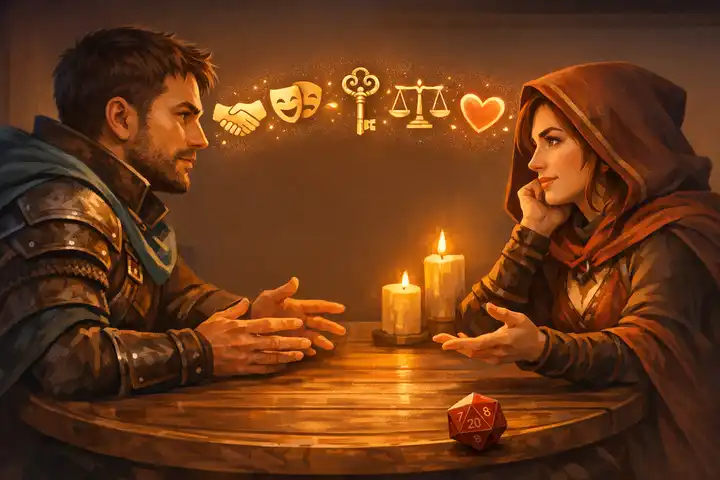
Tabletop RPGs go far beyond combat - social mechanics bring structure to conversations, negotiations, and relationships within the game. These systems help players navigate social interactions by relying on character stats and dice rolls, ensuring even shy players can roleplay bold characters. Here's a quick look at seven standout social mechanics that add depth and drama to RPG storytelling:
- Clock Mechanics: Gradually track progress in social conflicts, adding tension with visual tools like progress clocks.
- Influence Points: Measure and spend social capital to achieve short-term goals or build long-term reputations.
- Relationship Maps: Visualize connections between characters, factions, and locations, creating a dynamic social web.
- Manipulation Dice Pools: Combine stats and skills to resolve social interactions with nuanced outcomes.
- Divine Favor Meta-Currency: Use tokens earned through value-driven decisions to influence outcomes or request aid.
- Court Intrigue Subsystems: Frame political maneuvering as multi-round challenges involving the entire party.
- Powered by the Apocalypse Moves: Narrative-driven mechanics where actions shape outcomes, with partial successes adding complexity.
These systems make social interactions as engaging as combat, weaving player choices into the story and creating memorable moments at the table. Whether you're negotiating with a noble, forging alliances, or uncovering hidden motives, these mechanics ensure every conversation matters.

7 Social Mechanics in RPGs: Quick Reference Guide
Does D&D Handle Social Mechanics Well? ft. @TalesFromElsewhereGames
1. Clock Mechanics
Clock mechanics are a handy way to break down social conflicts into manageable steps, offering a structured alternative to relying on a single dice roll. Instead of immediately resolving a situation - like persuading a skeptical guard or earning the favor of a noble - these mechanics use a circular progress tracker, typically divided into 4, 6, or 8 segments, to show gradual progress. This approach has found its way into many popular RPGs.
In Blades in the Dark, for example, clocks are used to track a variety of situations, from "High Priest's Skepticism" to how alert guards become during a heist. The number of segments in a clock reflects the difficulty of the task: 4 segments for something moderately challenging, while 8 segments represent a more formidable hurdle. John Harper, the creator of the game, explains:
"The GM can use a clock to represent a progressive danger, like suspicion growing during a seduction..."
This system adds tension to failed rolls without immediately shutting down the player's efforts.
Clocks are great at showing the stakes without dictating the results. As one rulebook analogy puts it:
"A clock is like a speedometer in a car. It shows the speed of the vehicle - it doesn't determine the speed"
This visual tool gives players a clear sense of how close they are to success - or disaster.
Some RPGs take the concept further with variations like Tug-of-War clocks. These types of clocks fill or empty based on events, making them perfect for capturing the ebb and flow of conflicts, such as a fierce public debate or the shifting tides of public opinion during a rebellion. Similarly, Apocalypse World uses "Threat Countdown Clocks" to track escalating NPC plans or societal instability. In these clocks, the final three segments (9:00 to 12:00) share the same visual space as the earlier ones, signaling that events speed up as the situation approaches its climax.
Mike Shea from Sly Flourish offers practical advice for GMs:
"The segments in a progress clock should match an in-world situation... Match the number of steps to the in-world situation, not just an arbitrary number"
This flexibility has made clocks a go-to tool for tracking social dynamics and complex scenarios across various RPG systems.
2. Influence Points
While clock mechanics track gradual progress, Influence Points offer a way to measure and spend social capital in a more immediate and tangible way.
Influence Points act as a kind of social currency, turning your interactions into measurable values. Instead of relying on vague descriptions of how much an NPC likes or trusts you, this system assigns specific numerical values to your standing with individuals or organizations. Think of it like a bankable resource - you earn points through successful interactions and can "spend" them to achieve concrete outcomes.
This system works on two levels: short-term encounters and long-term reputation. Short-term encounters might include high-pressure scenarios like negotiating at a gala or persuading someone in a courtroom. For example, in Pathfinder 2e, players get 3 rounds (the equivalent of 45 minutes) to influence a landlord. Accumulating 4 points might secure an extra week of rent, 6 points could extend it by a month, and 8 points could reduce the rent while also forgiving half the debt. If players discover the landlord’s weakness - his love for old theater songs - they can lower the Performance check difficulty by 2. Successes and failures matter here: a Critical Success earns 2 points, a regular Success earns 1, while a Critical Failure deducts 1 point.
Long-term reputation, on the other hand, builds over the course of a campaign. This determines your influence with entire organizations, such as a Thieves' Guild or a Royal Court. Your standing might fall into categories like "Hunted", "Liked", or "Revered" based on your accumulated points. However, the stakes vary depending on the prominence of the group. For instance, gaining influence with a "Preeminent" organization like a national government takes four times as many points as influencing a "Weak" local faction. Completing favors for these groups typically earns between 2 and 5 points, but betraying them can cost you dearly - twice your current total points.
The GM Core describes this system as follows:
"Influence is a short-term subsystem wherein the PCs accumulate Influence Points during a social encounter with an NPC to represent their increasing influence. These encounters are a race against the clock to reach Influence Point thresholds in order to sway the NPC."
Reaching higher influence levels unlocks practical perks. These might include borrowing money or equipment, commanding small groups of NPCs, or even leveraging your reputation to gain favor with allied organizations. The key to success lies in versatility. Rather than relying solely on Diplomacy, players can use other skills tailored to the situation - like Accounting Lore to impress a merchant or Performance to charm a musician. This system adds a layer of strategy to social interactions, rewarding creativity and offering tangible benefits for your efforts.
3. Relationship Maps
After diving into systems like Clock Mechanics and Influence Points, Relationship Maps (or R-maps) bring a more visual method to track social dynamics within your game.
Think of R-maps as social network diagrams for your game world. They vividly illustrate the connections between characters, factions, and even locations - mapping out alliances, rivalries, and hidden motives. These diagrams are particularly good at highlighting uneven dynamics, like one-sided love or secret resentment, adding depth to the story. As Paul Beakley of the Indie Game Reading Club explains:
"Visual information is the strongest information... It is a living document, easily changed and grown as the game proceeds".
To create an R-map, start by placing characters, groups, or locations on a page, then draw lines to represent their relationships. Use it as a central, real-time tool that evolves with the game. For example, when a character dies or a faction collapses, mark them with a bold "X" instead of erasing their name. This keeps a visual record of the campaign’s history. Rob Donoghue, co-founder of Evil Hat Productions, points out:
"Organizing the information visually makes it easy for me to ask all the right questions when I want to do something in the setting, like 'Who will it impact? What effects will that have?'".
To make R-maps easy to read, use distinct shapes - like circles for player characters, rectangles for NPCs, and diamonds for factions. Add minimal details, such as age or gender, to avoid cluttering the map. If you’re playing in person, large butcher paper and bold markers like Sharpies are great for ensuring everyone at the table can see the evolving network. And don’t leave anyone out - make sure every character has at least one connection to avoid isolating them in the narrative.
R-maps have been a staple in games like Vampire: The Masquerade and Tokyo NOVA. More recent titles, such as Smallville RPG, Dungeon World, and Dogs in the Vineyard, have adopted similar tools, allowing players to visually track their growing web of social ties.
4. Manipulation Dice Pools
After visualizing connections through Relationship Maps, Manipulation Dice Pools bring a numerical edge to social interactions. These mechanics turn a character's social abilities into measurable results by combining key attributes - like Charisma, Manipulation, or Presence - with specific social skills such as Deception, Persuasion, or Fast Talk. It’s less about personal charm and more about how these elements work together.
The process is straightforward: declare your social intent, roll your dice pool, and compare it to the target's resistance score. This resistance determines the difficulty, using attributes like Intransigence or a defensive stat (e.g., Psychology). For example, in Call of Cthulhu 7E, interpersonal skills are rated from 1 to 99. The challenge ramps up to "Hard" when the target's defensive skill hits 50, and to "Extreme" at 90 or higher.
Modern dice pool systems often allow for nuanced outcomes. In Apocalypse World, rolling 10+ on 2d6 results in a strong success, while 7–9 represents a weaker success, shaping how NPCs might respond. The Librarian of Alexandria highlights the value of such mechanics:
"Social mechanics can produce interesting unplanned outcomes... [and] provide player affordances".
Justin Alexander from The Alexandrian adds further insight:
"The initial social skill resolution provides clues about what approaches might (or might not) work with the targeted character: Are they susceptible to bribes? A coward who can be intimidated?".
For critical negotiations, consider using a multi-step approach where multiple successes build momentum, reducing the risk of relying on a single roll. Pre-planning failure outcomes ensures players retain a sense of control and agency. This layered numerical system works seamlessly with visual and point-based tools, adding more depth and strategy to social gameplay.
5. Divine Favor Meta-Currency
Blending supernatural elements with social mechanics, Divine Favor Meta-Currency offers a fresh twist to traditional roleplaying systems. Instead of relying solely on dice rolls or stats, players earn tokens symbolizing their relationship with a deity. These tokens act as a narrative tool, allowing players to directly influence outcomes when it matters most. By shifting the focus from random chance to strategic storytelling, this mechanic adds a layer of depth to player decisions.
Earning Divine Favor requires aligning with a deity's values through meaningful choices. As Hannah L. from Roleplaying Tips Newsletter explains:
"Divine Favor Points can only be earned by extraordinary actions. Slaying zombies and wraiths pleases the Raven Queen, but she won't give the cleric points for it".
Players accumulate these points by making tough, value-driven decisions. For instance, to gain favor with Vecna, a player might accept a subservient zombie as an ally. On the other hand, destroying that same zombie could align with Pelor's ideals. This dynamic creates tension between personal objectives and divine expectations, rewarding players who embody their deity’s ethos.
Once earned, Divine Favor tokens grant players the power to shape outcomes. Spending these tokens can influence social interactions or even bend the narrative. For example, tokens might allow a player to reroll an NPC's reaction, transforming a hostile encounter into a friendly one. They can also request "minor miracles", like uncovering a hidden tool or finding an unlocked terminal at a critical moment. However, the catch is that spending tokens must align with the domain of the deity. A war god might only grant aid in battle, while a death goddess might intervene in matters of life and death.
Some systems introduce an added layer of complexity by allowing players to spend beyond their earned tokens. If a character accrues too much debt (e.g., -3 tokens), they risk losing their divine powers until they redeem themselves. This mechanic adds a calculated risk to every expenditure. As Mattsall from Nerdaphernalia puts it:
"The PCs gain Favor Points with each Deity individually and can spend them by praying to that god for assistance. But not every god can help in anyway".
This creates a strategic challenge where players must carefully decide which deity to prioritize, based on the trials they expect to face.
6. Court Intrigue Subsystems
Court intrigue subsystems take the chaos of political maneuvering and turn it into structured, multi-round challenges. These systems build on earlier mechanics, offering a deeper dive into social gameplay by framing interactions as strategic exchanges over several rounds. Instead of resolving with a single roll, players earn Victory Points - often rebranded as Influence or Reputation Points - as they work to sway NPCs or entire organizations. This approach mimics the back-and-forth tension of combat, but with words, leverage, and relationships as the tools of engagement.
What makes these systems stand out is their ability to involve the entire party, not just the charismatic "face" of the group. Take Pathfinder's Influence subsystem as an example: it allows multiple skills - like Lore, Perception, and Society - to contribute to the outcome. Before players even attempt to persuade a key NPC, they enter a Discovery phase. Here, skill checks help uncover hidden biases, personal vulnerabilities, or other factors that might complicate their efforts. Typically, players need 7–10 points to achieve their goal, with each success earning 1 Influence Point and critical successes awarding 2.
Some systems push this concept further by treating debates as "social combat", where verbal sparring drains a character’s mental endurance. For example, a Game Master might assign 20 points across an NPC's various motivations, allowing players to strategically target areas where they can gain the most leverage. As Skye Lansing explains:
"Any scene that focuses on social aspects rather than open conflict can be thought of as a political exchange in one form or another".
This design transforms vague social interactions into clear mechanical challenges with measurable outcomes.
Games like Court of Blades take these mechanics to the next level, shaping entire campaigns around intrigue. This Forged in the Dark game, priced at $25.00 for the digital version, immerses players in "The Great Game" of Renaissance Ilrien. Here, players act as retainers for their Noble House, navigating a world of alliances and rivalries. The game has earned a 4.9/5 star rating on itch.io, based on 49 reviews, and was featured in Gizmodo's Top 20 TTRPGs of the year. It introduces unique mechanics like spending "Stress" to trigger flashbacks for preparation or using the "Paramour" feature to recover stress or gain assistance during missions.
The most engaging intrigue systems treat social skills as tools for gathering knowledge rather than automatic wins. For instance, passing a social skill check might reveal an NPC's hidden motivations or biases. Reaching specific point thresholds can unlock rewards - like a minor favor at 4 points or a major alliance at 8 - forcing players to make tough decisions about which NPCs to prioritize and which strategies to use. On the flip side, a critical failure can undo their progress, adding to the suspense. This layered approach to political gameplay sets the stage for even richer mechanics, as seen in Powered by the Apocalypse moves.
7. Powered by the Apocalypse Moves
Powered by the Apocalypse (PbtA) moves take a refreshing approach to game mechanics by shifting the emphasis from rigid rules to storytelling. Instead of rules dictating the narrative, the narrative takes the lead, shaping how and when rules come into play. Players describe their actions first, and those actions determine the moves they make.
As Vincent Baker, co-creator of Apocalypse World, puts it:
"Fictional causes have real-world effects. Real-world causes have fictional effects".
Here’s how it works: rolling a 10+ delivers a solid success, 7–9 results in a partial success with consequences, and 6 or less triggers a Game Master (GM) move. That middle range - 7–9 - is particularly interesting because it keeps the story moving by offering a win that comes with a cost, making outcomes more dynamic and layered.
PbtA moves also handle social conflicts in unique ways. When a character escalates a situation, the opposing player is often given a choice, adding depth to the interaction.
Different PbtA games tailor their moves to reflect specific social dynamics. For instance, Apocalypse World uses moves like Seduce or Manipulate and Go Aggro to heighten tension, often driving situations toward violence or uneasy compromises [63,66]. On the other hand, Under Hollow Hills focuses on relationships, featuring moves such as Open Up to Someone and Lay Someone Bare, which aim to deepen emotional connections rather than spark conflict [64,66]. These diverse approaches highlight the adaptability of PbtA systems in crafting nuanced social mechanics. The popularity of this design is evident, with over 800 products on Itch.io tagged as PbtA, reflecting its broad appeal.
At their core, PbtA moves turn social interactions into narrative tools. They establish clear "permissions and expectations", helping players navigate who asks questions, who answers, and how everyone contributes to the unfolding story. Whether negotiating with a gang leader or exposing a character's hidden fears, these moves ensure that mechanics serve the story, enhancing the drama instead of interrupting it.
Conclusion
Social mechanics open up new possibilities at the gaming table. By offering "affordances", these systems suggest actions players might not naturally consider - like calling in a favor, uncovering hidden motives, or leveraging a group's reputation. They act as a bridge between a player's own skills and their character's abilities, making it easier for even quieter players to step into the role of a persuasive diplomat.
More than just rule sets, well-crafted social mechanics add depth to storytelling. They create unexpected twists and memorable moments that elevate the narrative. As Justin Alexander, RPG designer and author, puts it:
"Social skills... when used appropriately, can actually enhance and improve the aspects of the game that they so often harm instead".
Rather than replacing roleplay, these systems act as prompts, sparking improvisation and enriching the story.
They also weave characters into the game's social structure. Tools like relationship maps or influence points embed characters into a living, dynamic world. While Dungeons & Dragons 5th Edition identifies social interaction as one of its "three great pillars" alongside combat and exploration, it often lacks the same level of mechanical depth in this area. Games that focus on social systems fill this gap, turning conversations and relationships into meaningful gameplay.
For those eager to dive into RPGs with strong social mechanics, the TTRPG Games Directory at https://ttrpg-games.com is a valuable resource. Whether you're drawn to tactical social combat, emotionally charged narratives, or systems that use abstract elements like "Strings" or "Influence", the directory offers detailed descriptions of each game's features. You can filter by social subsystems, search for specific moves like "Read a Person", or even find games with mechanics that let players directly shape the story. It’s a great way to discover systems that bring these mechanics to life.
The right social mechanics transform tabletop RPGs into collaborative storytelling adventures where every conversation holds weight and every relationship leaves its mark.
FAQs
How do clock mechanics add tension to social interactions in RPGs?
Clock mechanics add a layer of tension to RPG social interactions by introducing a visual and time-sensitive challenge. As the clock advances, players feel the pressure build, highlighting the stakes and injecting a sense of urgency into their decisions.
This design keeps players on their toes, requiring them to think fast and plan carefully to avoid undesirable outcomes. The ticking clock transforms social encounters into more dynamic and suspenseful moments, making the storytelling feel more immersive and engaging.
How do Influence Points enhance social interactions in RPG campaigns?
Influence Points bring a new layer of complexity to RPG campaigns by quantifying a character's social standing and relationships within the game world. They represent a character's knack for persuading NPCs, securing favors, or even challenging powerful organizations, turning social interactions into strategic opportunities.
With Influence Points, players can tap into exclusive perks like special resources, forming alliances, or steering events in their favor. This system encourages players to think outside the box, enhancing role-playing experiences and making interactions feel more dynamic and lifelike. It’s a tool that deepens immersion and makes the game world react meaningfully to player actions.
What role do Relationship Maps play in enhancing storytelling in RPGs?
Relationship maps are an excellent resource in RPGs, offering a visual way to track how characters are connected - be it through friendships, rivalries, or alliances. They serve as a quick reference for both players and Game Masters (GMs), making it easier to grasp the complex social dynamics at play in the story.
By clearly laying out these connections, relationship maps enhance immersion and fuel narrative growth. They also act as a springboard for adding tension, stirring up drama, or revealing hidden ties, making the game world feel richer and more intertwined.


